
Berkeley Resident Records, By Type
A Berkeley resident lookup is a route through separate custodians, not a single public name list. The Alameda County property search begins with an address or APN and does not show a public owner-name mode. The Recorder index is organized by party name, while permits, court files, directories, and vital records have their own limits. A coverage table keeps the question and the access point together so a name search does not overstate what a result proves.
| Record | What It Confirms | Where to Search | Access |
|---|---|---|---|
| Parcel and tax | Property connection, situs and mailing clues | Alameda Property Search | Free address or APN search |
| Deeds | Recorded parties and transfer chain | Alameda Official Public Records | Name index from 1969; microfilm earlier |
| Voter status or file | Own status and address, or an approved file | California My Voter Status | Authenticated self-use or restricted purpose |
| Court and probate | Case and party information by case type | Alameda eCourt | Account, court rules, and copy charges |
| Vital records | Birth, death, marriage, or dissolution event | CDPH Vital Records | Informational or authorized access |
| Permits | Applicant, owner lead, project, and address | Berkeley permit systems | Online and microfiche channels |
| Historical directories | Listed address, occupation, or subscriber | Berkeley Public Library History Room | Free digital links and onsite shelves |
| Obituary and death index | Death, residence clues, and relatives | Berkeley Gazette obituary index | Free name and date search; partial years |
| Business and licenses | Professional or organizational affiliation | California DCA and bizfile Online | Free metadata, not residence proof |
Choose the first record by the fact already in hand. An address points toward GIS, parcel, tax, permit, and deed sources. A relative or death date points toward the obituary index and probate. A school year points toward yearbooks. A professional name may produce a DCA license or business filing, but that is an affiliation clue rather than proof that a person lives in Berkeley.
Note: A parcel result can locate a property, but it does not establish who currently occupies the dwelling.
Alameda eCourt Checks Party Names
The Alameda Superior Court eCourt Public Portal covers Civil, Family Law, Probate, Mental Health, and Adoption searches. Account registration is required for any portal function. A result can show case and party information, while the document area offers a half-page preview and charges for downloading or printing. The research could not verify the exact party-search fields or current prices because those details sit behind the account gate. That gap should be stated plainly instead of filled with guessed filters.
Berkeley Courthouse is a county Superior Court location, not a city or municipal court. Public civil terminals are available at the Rene C. Davidson Courthouse, and mail record searches remain a fallback. Criminal documents use Criminal Record Requests. Family-law documents are not remotely online through the ordinary path. Probate filings after January 31, 2006 may have images, except for conservatorship, guardianship, and confidential documents. Traffic files are paperless and can be printed at any Traffic Court location. Adoption access requires a court order, while juvenile records require a JV-570 petition under Welfare and Institutions Code section 827.
For a visual of the access split, consult the Alameda court records request guide before choosing a remote, mail, terminal, or counter route.
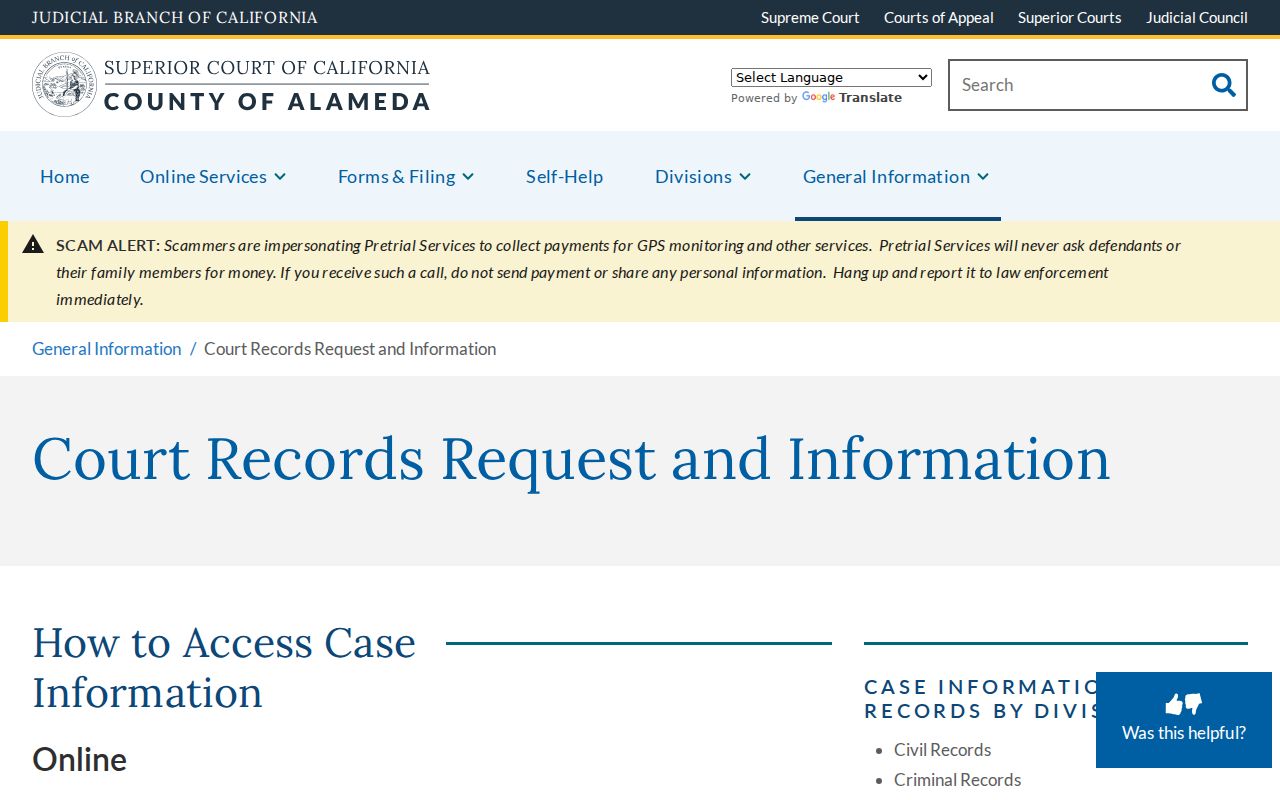
The guide reinforces the main rule for an Alameda resident lookup: case type controls access. A missing online document may reflect confidentiality, an older file, or the wrong request channel rather than a missing event.
Berkeley Vital Records Need the Right Copy
Birth, death, marriage, and dissolution records are not interchangeable. Alameda County Clerk-Recorder handles county events, while the California Department of Public Health maintains the statewide channel. In 2026, the published certificate fees differ by keeper. A county request can be useful for a local event, while CDPH is the statewide route. Confidential marriage records have narrower access, and a divorce certificate is not the same document as the Superior Court decree or case file.
| Record | County custodian | State custodian | 2026 fee |
|---|---|---|---|
| Birth | Alameda Clerk-Recorder, $36 | CDPH, $31 | Informational or authorized |
| Death | Alameda Clerk-Recorder, $28 | CDPH, $26 | Informational or authorized |
| Public marriage | Alameda Clerk-Recorder, $21 | CDPH, $19 | Informational or authorized |
| Confidential marriage | County Clerk, $21 | No state public option shown | Parties or court-authorized access |
| Dissolution certificate | Superior Court decree or file | CDPH certificate, $18 | Do not confuse certificate with decree |
Health and Safety Code section 103526 separates authorized copies from informational copies. An authorized copy may establish identity. An informational birth, death, or public-marriage copy carries a diagonal notice and cannot establish identity. Authorized requests use a notarized sworn statement and a qualifying relationship or status. The application forms and checkbox details should be read directly on the state forms. California does not use a simple rule that every birth or death becomes open after a set number of years. The State Archives policy for records older than 75 years is not a general vital-record opening statute.
County online ordering adds $2 per order. If no record is found, the search fee is retained and a Certificate of No Record is issued. CDPH sends copies by First Class Mail, not email or fax, and cannot pre-check whether a record exists. Its current average certified-copy processing time is 4-6 weeks. For a new birth or death, county or local ordering is recommended during the first three months; for a new marriage, the local channel is recommended during the first six months.
The Alameda County vital-records page shows the local certificate route and the practical distinction between certificate choices and eligibility.
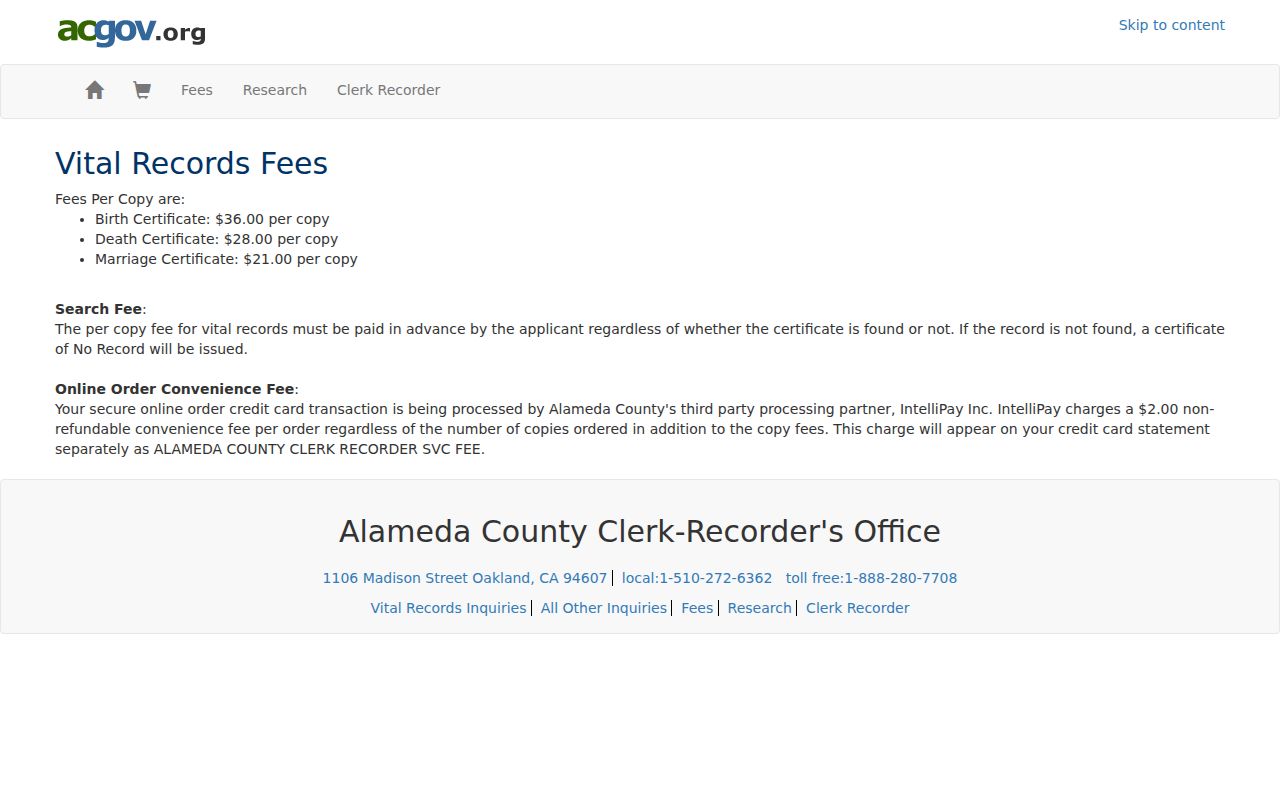
That ordering view belongs beside the county fee schedule, not in place of it. The custodian, event type, copy type, and qualifying status all matter.
State applications also carry the 2026 fees and sworn-statement route. The CDPH vital-record fee schedule lists the current state amounts. Read the state certificate applications before mailing a request, especially when an authorized copy is needed. The Alameda vital-record order form shows the county's authorized and informational choices.
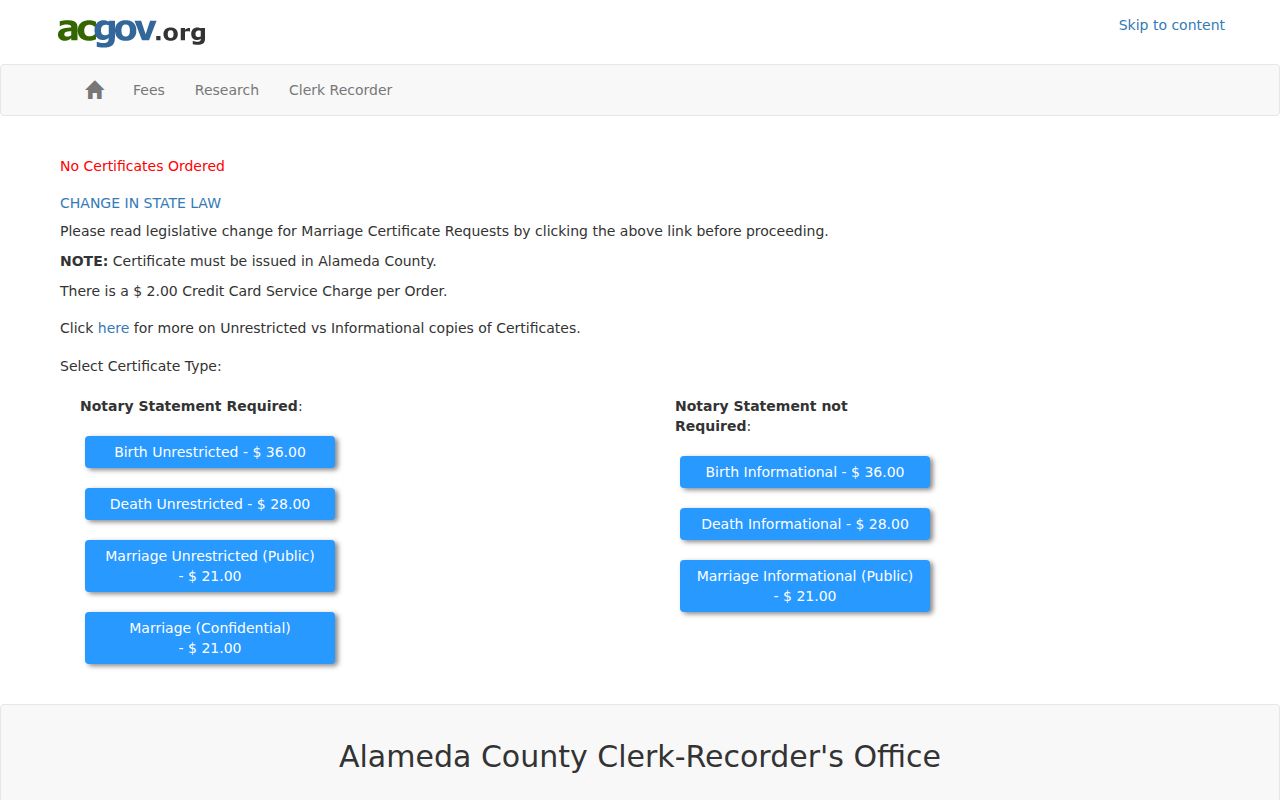
The second image makes the access choice visible, while the record itself remains a custodian-held source rather than a general name index.
Note: No simple N-year rule was verified for modern California vital records, so an old date alone does not guarantee an open certified copy.
One Berkeley Person, Two Strong Matches
Common names require a second anchor. Preserve middle initials, suffixes, alternate spellings, nicknames, spouse names, and a date or place before treating a result as the right person. The Berkeley property interface can connect an address to an APN and separate a situs address from a mailing address, but it has no displayed public owner-name search. A deed is a recorded transfer, not an occupancy list. A directory line is a listed subscriber or occupant clue, not a complete household.
The Alameda property portal does not prove who lives at an address. It locates parcel facts and a possible ownership lead, then needs an independent record.
A useful sample inventory for a resident lookup includes these fields:
- Party name, alternate spelling, and role in a deed or case.
- Address, APN, situs or mailing label, and the date tied to it.
- Document type, recording date, instrument number, book and page, or reel and image.
- Case number, case type, party entry, and the narrow preview available through eCourt.
- Directory year, occupation or business line, subscriber mark, and street sequence.
- Vital event type, copy category, relationship qualification, or certificate status.
Two independent matches can be an address plus a deed party, a yearbook entry plus an obituary, or a case name plus a dated address. A professional license or business filing may strengthen an identity link, but it should stay labeled as an affiliation clue. When a result conflicts with a later record, keep the dates and roles separate instead of forcing one story.
Verify a Berkeley Resident in Sequence
For a one-person verification, begin with the least sensitive fact already known and move toward a record that can confirm it. The sequence below is designed for a name that needs an address or a known address that needs a name. It also leaves a clear trail for an heir, a former classmate, or a family researcher to review later.
- Write down the name exactly, then add initials, suffixes, spellings, spouse names, a year, or a known Berkeley connection.
- Anchor the search with an address, APN, document or license number, case number, yearbook year, or date of birth.
- Use the property or GIS address route only to locate a parcel and possible owner or mailing lead.
- Check the Alameda Recorder party index from 1969 forward, then move to 1853-1968 microfilm when the trail is older.
- Compare the result with a court party entry, directory line, obituary, permit, or vital record that carries a different date or role.
- Order a certified copy only after the event and eligibility match, and ask the actual custodian to correct a source error.
A docket is the court's case record or case-entry trail. An index is a finding aid; an image is the scanned or filed document behind that entry. A certified copy is an official copy issued under the custodian's rules. Those terms matter because a free search result, a preview, and a certified document do not carry the same weight.
- Docket
- A case-level record of filings, parties, and events, subject to the court's access limits.
- Index versus image
- An index points to a record; an image or file is the underlying document, which may be restricted or paid.
- Certified copy
- A custodian-issued copy with a certification statement, available only when the request qualifies.
Berkeley Lookup Paths for Family Questions
An heir search can move from the Berkeley Gazette obituary index to a probate case and then to a recorded transfer. The index accepts last name, first name, middle or nickname, month, and year, with an asterisk wildcard. It has documented coverage for 1894-1910, 1920, 1923, 1925, 1930-42, 1951, 1955, 1959-65, 1967, 1970-71, 1977-80, and 1982, with other years in progress. A missing year is not proof that a death or family moved elsewhere.
A former classmate can be approached through a Berkeley High yearbook, a directory or telephone book, and an obituary or alumni channel. The Berkeley Public Library History Room holds Berkeley High yearbooks, UC Blue and Gold, newspapers, maps, directories, and research help. A birth-parent question has a different path: California's official adoption and vital process applies, and a sealed adoption is not an open resident search. Do not turn a genealogy clue into a claim about a living person's present address.
Berkeley Voter Status Is Authenticated
California My Voter Status is a self-only authenticated lookup, not a public name or street directory. It asks for the exact first and last name, date of birth, and either a California driver license or ID number or the last four digits of a Social Security number, with an option to say that an identifier is not available. A successful self-check can show registration status and address, party preference, language preference, polling place, upcoming election, vote-by-mail or provisional status, participation history, and guide preference.
| Field | Type | Required | What it does |
|---|---|---|---|
| First Name | Text | Yes | Matches the registered name |
| Last Name | Text | Yes | Matches the registered name |
| Date of Birth | Date selectors | Yes | Authentication match |
| California driver license or ID | Text | Conditional | Use the available identifier |
| Last four of SSN | Text | Conditional | Alternative identifier |
| Submit or Continue | Button | Required to run | Returns the self-status result |
A qualified voter file is a separate request. Candidates, committees, and approved election, scholarly, journalistic, political, or governmental users must state the purpose and detailed use, requested scope, delivery method, acknowledgments, and beneficiary or applicant information. The application requires a wet signature, photo ID, and fee, and must be mailed, couriered, or delivered in person. Email and fax submission are not accepted. Review usually takes 7-14 business days.
The published fee is $15 per 1,000 records, with a $15 minimum and $100 maximum; a statewide file is $100. A specific-voter request is $30 per person, capped at $100 for up to ten. Data may include name, date of birth, registration date, residential or mailing address, precinct, contact information, party, status, and participation history. Driver license or state ID numbers, Social Security numbers, unique identifiers, and signatures are excluded. Confidential voters and 16-17-year-old preregistrants are excluded. The public status portal cannot enumerate Berkeley neighbors.
Berkeley Custody Records Have Narrow Routes
Some identity-bearing searches are public only in a narrow, current form. The Alameda County Sheriff inmate locator accepts a PFN or first and last name, with middle name, sex, date of birth, phonetic search, and CAPTCHA options. The CDCR CIRIS locator searches a name or CDCR number for current state custody details. California Megan's Law has its own name, city, county, ZIP, and address-vicinity disclosures, with omissions and misuse rules. None is a complete history of a Berkeley resident.
The Alameda inmate search illustrates why a dynamic result must be read as current custody information, not a permanent identity profile.
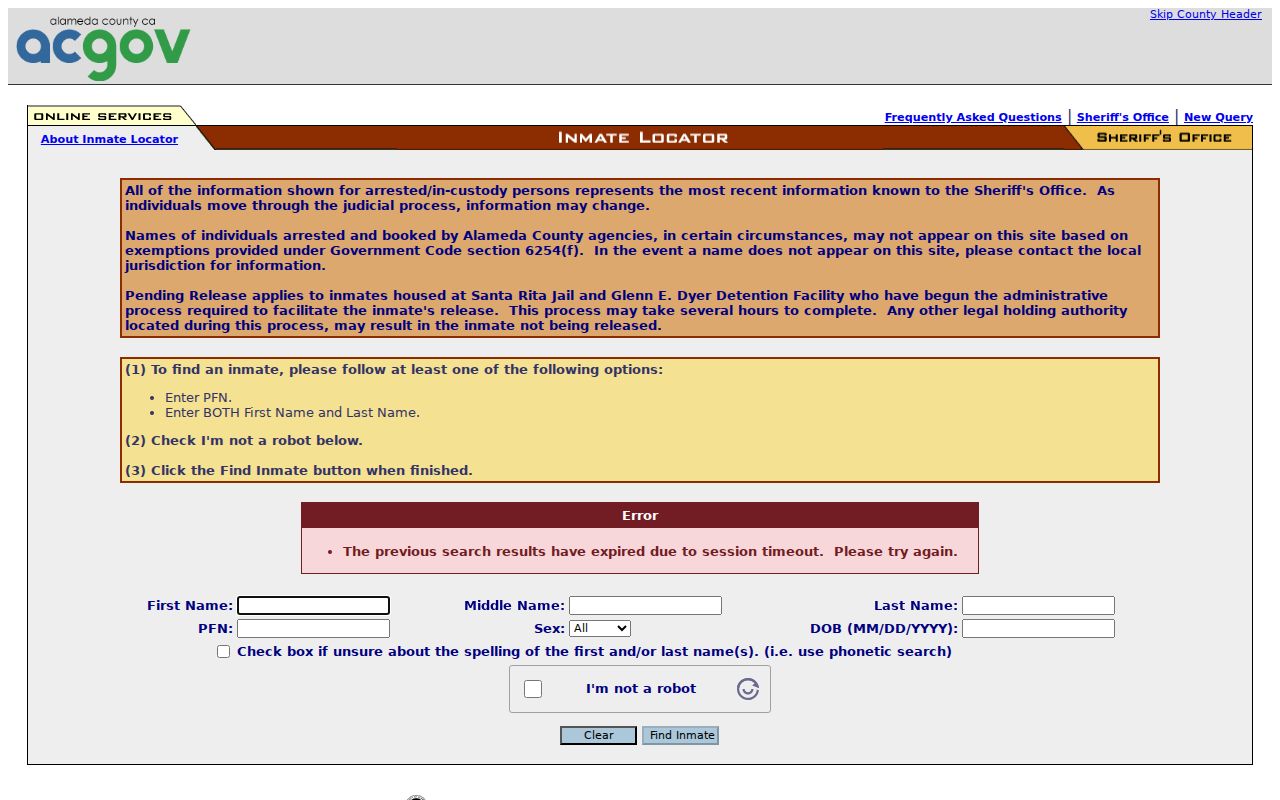
Its notices say that data can change during judicial processing. A pending release may take hours or be stopped by another hold. The California CDCR inmate locator supplies a separate state custody route.
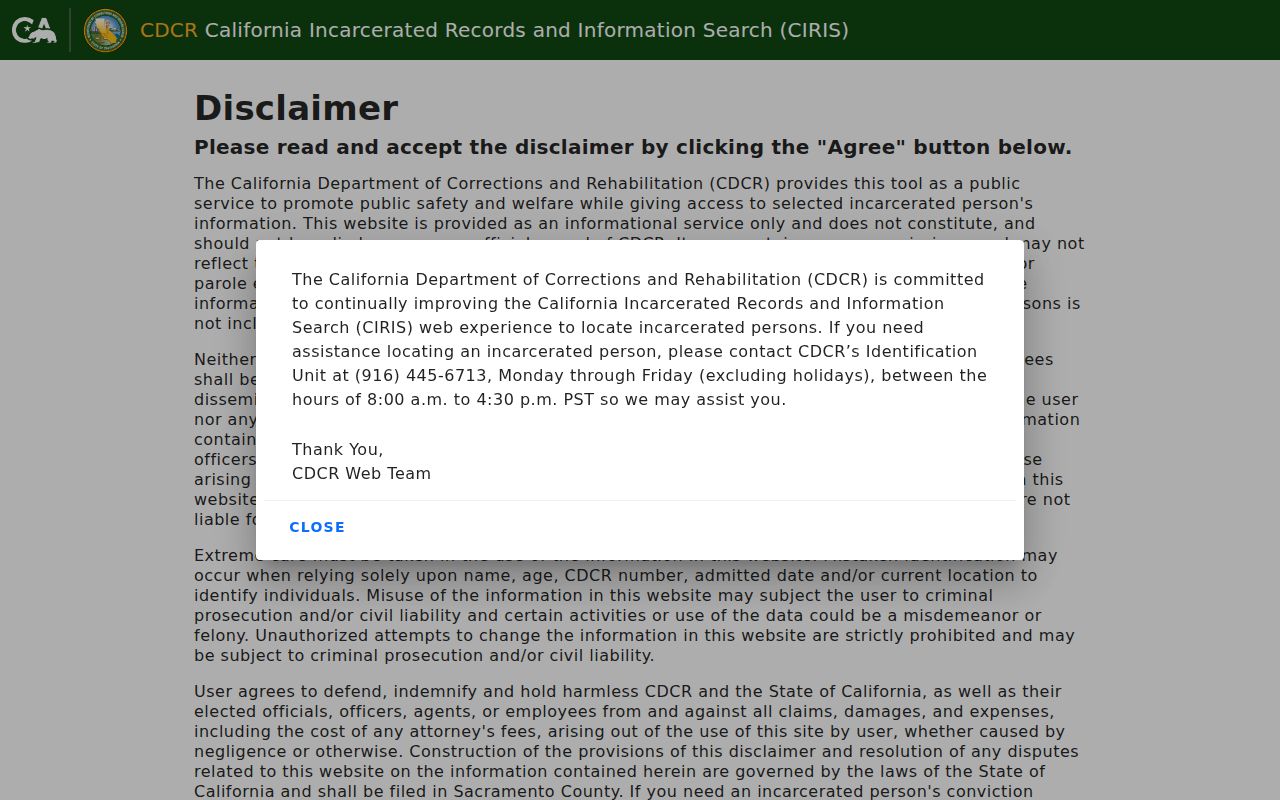
For registrant information, use the California Megan's Law registry and follow its access and misuse rules.
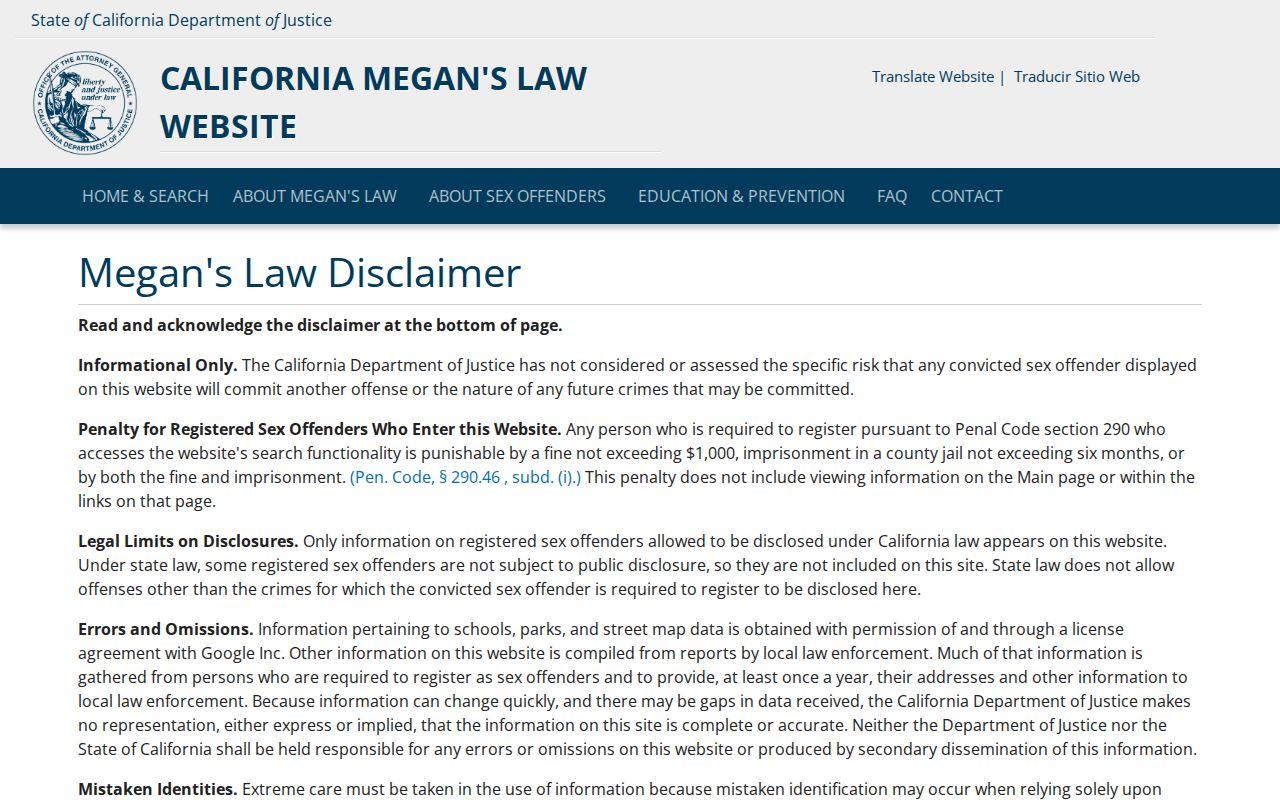
The three pathways answer different custody or registry questions. They should never be blended into a claim that a person is present, absent, safe, or dangerous today.
When Berkeley Records Need a Request
Online access is only one channel. Berkeley Records Online and NextRequest cover city documents, while the City Clerk accepts help requests, mailed or in-person Public Records Request Forms, and anonymous requests. An anonymous requester can receive the disclosure but does not receive account updates. Review is free. Standard paper copies cost 10 cents single-sided or 20 cents double-sided. The City generally makes a disclosure determination within 10 days, with a possible 14-day extension.
The California Public Records Act, Government Code section 7920.000 and following, gives a broader request path when a city record is not in a search interface. An agency may redact exempt material and release segregable material. Direct copying costs may apply, while compilation, extraction, or programming can carry actual cost. County court, Recorder, vital, and election systems remain separate custodians, so a Berkeley request should name the record holder and the record type rather than ask for an undefined resident file.
Correction follows the source. A copied directory entry, commercial compilation, or search result cannot amend a deed, parcel record, voter record, court file, or vital certificate. Keep the document date, instrument or case number, and the office that issued it. Then use that office's correction, appeal, or records-request channel. A no-match result may reflect authentication, confidentiality, an index gap, spelling, or a record held in another jurisdiction.
California's 2026 DROP system can send one encrypted deletion request to registered data brokers, but broker deletion does not rewrite a Berkeley deed, parcel, voter, court, or vital source.
For a source request or correction trail, the Berkeley public-records access page identifies Records Online, NextRequest, copy costs, timing, and request channels.
Lawful Berkeley Resident Lookup
California Safe at Home can give qualifying survivors and threatened people a substitute mailing address, confidential voter registration, mail forwarding, and some name, DMV, and property protections. It does not automatically erase older public records. The California Consumer Privacy Act provides access, deletion, correction, opt-out, sensitive-data limits, and nondiscrimination rights, but public-record information may be exempt. Government Code sections 6205, 6208.1, and 6209.5 govern major Safe at Home protections.
Lawful use. Berkeley resident lookup is for personal, lawful research, family history, civic understanding, and safe reconnection. Repeated malicious following, publishing identifying information to incite unwanted contact, voter-data misuse, stalking, harassment, or intimidation can violate California law.
Penal Code sections 646.9 and 653.2 address stalking, threats, and publishing identifying information to provoke unwanted contact or harm. Elections Code section 18109 makes unauthorized voter-data use a misdemeanor. If a record looks wrong, pause before sharing it, verify the custodian, and ask the issuing office to correct the source. A careful resident lookup protects the difference between a clue and a confirmed record.