
Berkeley’s Historical Directory Shelf
Berkeley's historical directory shelf reaches back before city incorporation and continues through printed runs, reverse books, census films, maps, newspapers, and yearbooks. The Berkeley Public Library History Room is the main local access point, with curated digital links and noncirculating print material. BHS and BAHA add reverse books, early permits, block books, and original maps. Keeping the collections separate matters because a name directory, an address-first book, a census, and a Sanborn map answer different questions.
| Collection | Years | Where Held | Access |
|---|---|---|---|
| East Bay and Berkeley directories | 1867, 1869, 1874, 1875, 1876-77, 1877-78, 1880-81, 1884-85, 1887, 1889-90, 1892-93, 1903, 1908-18, 1921, 1923-28, 1930, 1933-35, 1937-41, 1943 | Berkeley Public Library curated digital links and History Room | Free links; print is noncirculating |
| Polk print directories | 1883-1943 documented span | Berkeley Public Library, BHS, and BAHA | Room or archive access |
| PT&T reverse directories | 1938, 1940, 1944 | Berkeley Public Library digital links | Address to subscriber |
| Oakland-Berkeley telephone book | 1916 | Online link | Digital |
| Later reverse directories | 1981-present; some 1960s-70s | History Room and BHS | In person |
| Federal census microfilm | 1860-1930 local; public schedules through 1950 | History Room and Ancestry | Onsite research |
| Sanborn maps | 1890, 1894, 1911, 1929, 1950 | BPL; originals at BAHA and BHS; 1894 UC digital | Room or digital access |
| Berkeley Daily Gazette | 1894-1984 | History Room microfilm | Onsite; obituary index online |
| Berkeley High yearbooks | Physical 1943-present; digitization report 1895-2012 | BPL and Internet Archive links | Room or digital access |
| UC Blue and Gold | 1886-2006 | History Room | Onsite research |
Do not read the table as a promise of an unbroken annual run. The East Bay and Berkeley list has named gaps, while the documented Polk span covers 1883-1943. From 1923, Berkeley may be interfiled with Oakland. The Berkeley Public Library warns that linked 1967 and 1969 volumes are Oakland only, so a link labeled by year is not enough. Start with the volume note or page sequence, then record the publisher and place heading before copying a name.
The Berkeley Public Library History Room collection identifies the local maps, newspapers, directories, and research services that surround the city directory shelf.
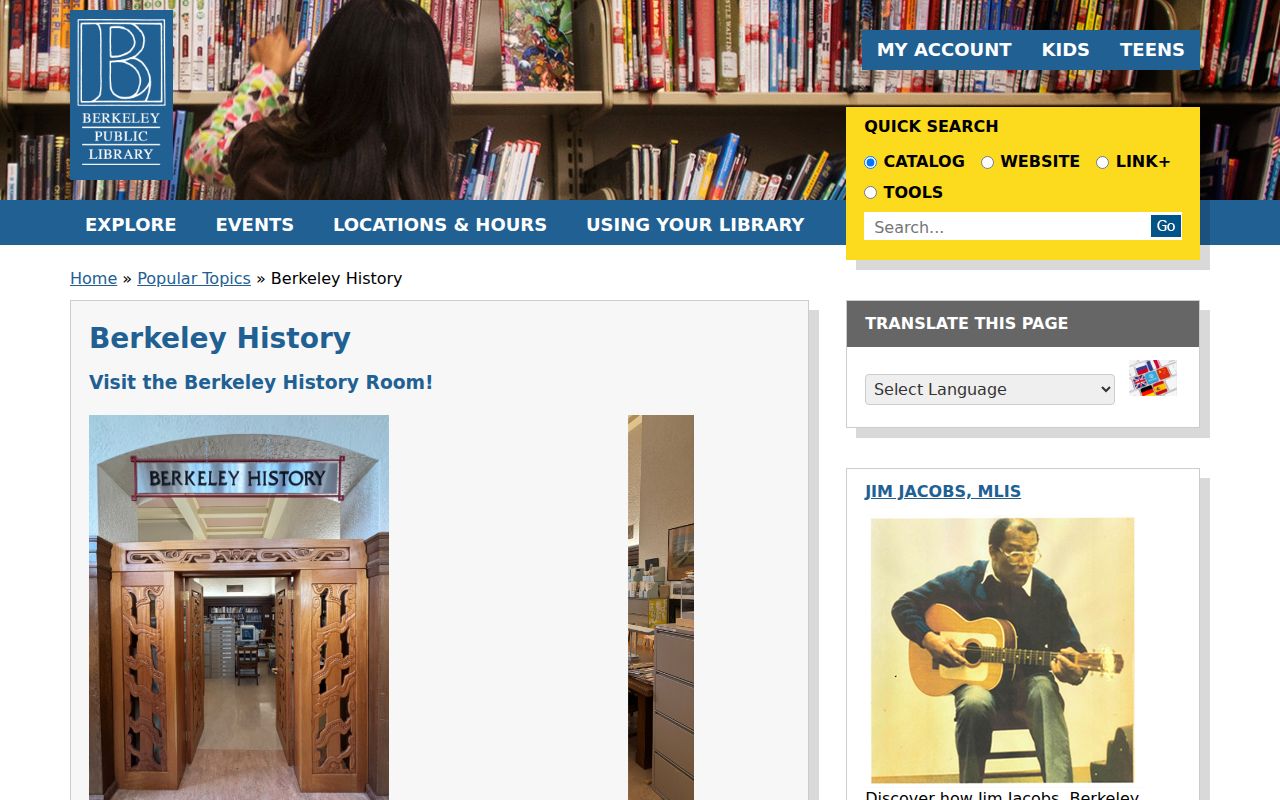
The History Room's noncirculating holdings make the printed Berkeley volume useful even when a linked scan does not cover the needed year.
The digitized volume and telephone-book list helps identify which year and publisher a digital link represents.
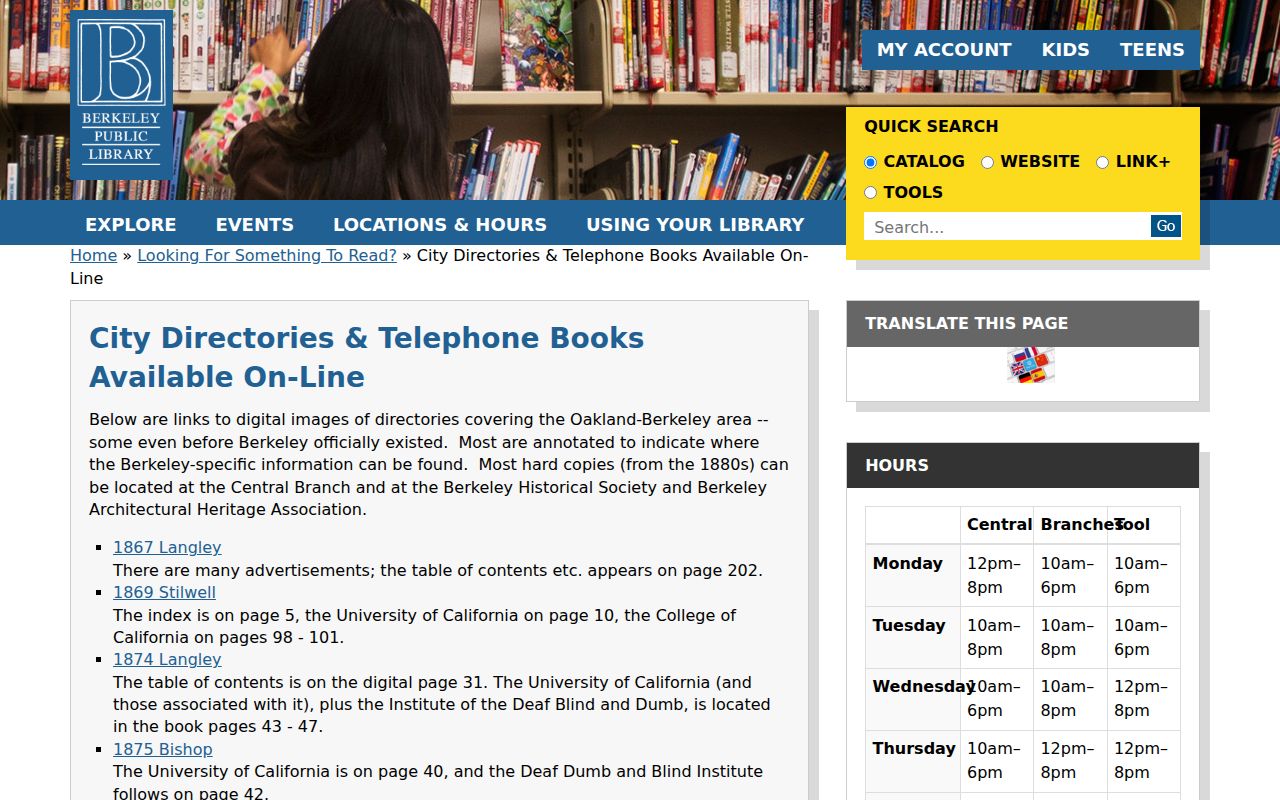
That annotation is especially useful when a Berkeley volume sits inside an Oakland-Berkeley run or when a linked title names only Oakland.
Berkeley's Early Directory Trail
Berkeley's directory story begins before Berkeley incorporated in 1878. Alameda County was created in 1853, but East Bay volumes already carried local names in 1867, 1869, 1874, and 1875. Before a municipal Berkeley heading becomes reliable, search the UC and College of California institutional pages. Those pages can hold people who would be missed by a narrow city-name search.
Three page checks are unusually useful. In the 1869 volume, inspect UC page 10 and the College of California pages 98-101. In 1874, check the institutional pages 43-47. In 1875, check UC page 40. The later runs also have navigation clues: Berkeley begins at page 513 in 1880-81, 628 in 1884-85, 836 in 1887, 977 in 1889-90, 754 in 1892-93, and 544 in 1903.
Early UC entries are a local history story as much as a name index. Student and faculty turnover means that one-year absence is weak evidence. Pair an early directory hit with a yearbook, UC archive, census page, or later Berkeley directory before deciding that a person left the area.
Berkeley Publishers Across the Directory Timeline
Publisher changes help place a Berkeley volume in sequence. They also prevent a researcher from treating every scan as part of one continuous series. The documented runs identify Langley, Stilwell, Bishop, Polk-Husted, Husted, and R.L. Polk, with the later Polk books often carrying Berkeley inside a wider Oakland-Berkeley arrangement.
- 1867 and 1874: Langley volumes mark the earliest named publisher runs.
- 1869: Stilwell supplies an East Bay volume with the UC and College of California page trail.
- 1875 through 1880-81: Bishop appears across the early Berkeley sequence.
- 1884-85, 1889-90, 1892-93, and 1903: Polk-Husted volumes fill documented milestones.
- 1887 and 1908-24: Husted is the named publisher for those runs.
- 1925-43: R.L. Polk dominates the documented later print span.
The 1908-18 run, the 1921 volume, the 1923-28 group, and the 1930, 1933-35, 1937-41, and 1943 books are best read with their own place headings. Note: A Berkeley name can shift between Berkeley and Oakland headings without the household moving or the directory link being wrong.
How a Berkeley Directory Entry Reads
An entry should be treated as a compact index, not a complete household file. The local workflow is clear even though an actual image entry was not reliably inspected during research: alphabetical pages lead from a name to a listed address, occupation, or business, while reverse PT&T volumes lead from an address to a subscriber. Preserve the spelling and punctuation shown in the volume.
Use this inventory as a reading log. A blank field is meaningful, and a role should never be filled from guesswork.
| Name | Alphabetical headword as printed, including initials or nicknames. |
|---|---|
| Address | Listed house number and street, or the address that led to the reverse entry. |
| Occupation or business | The occupation, business, or institutional line shown beside the name, when present. |
| Spouse or household note | Record a relation only when that particular volume prints one; do not supply it by assumption. |
| Role check | Keep the listed subscriber, occupant, owner, and household member as separate possible roles. |
- Criss-cross directory
- An address-first section that lists subscribers in street sequence instead of beginning with a surname.
- Householder index
- A name-first list that points to the listed person or household address.
- Abbreviation key
- The volume's explanation of short forms; use it before expanding a mark or title.
- Listed subscriber
- The person or organization named for the service or address, not automatically every person present there.
The History Room directory and telephone-book holdings are the best local starting point for identifying the reverse volumes and blue books.
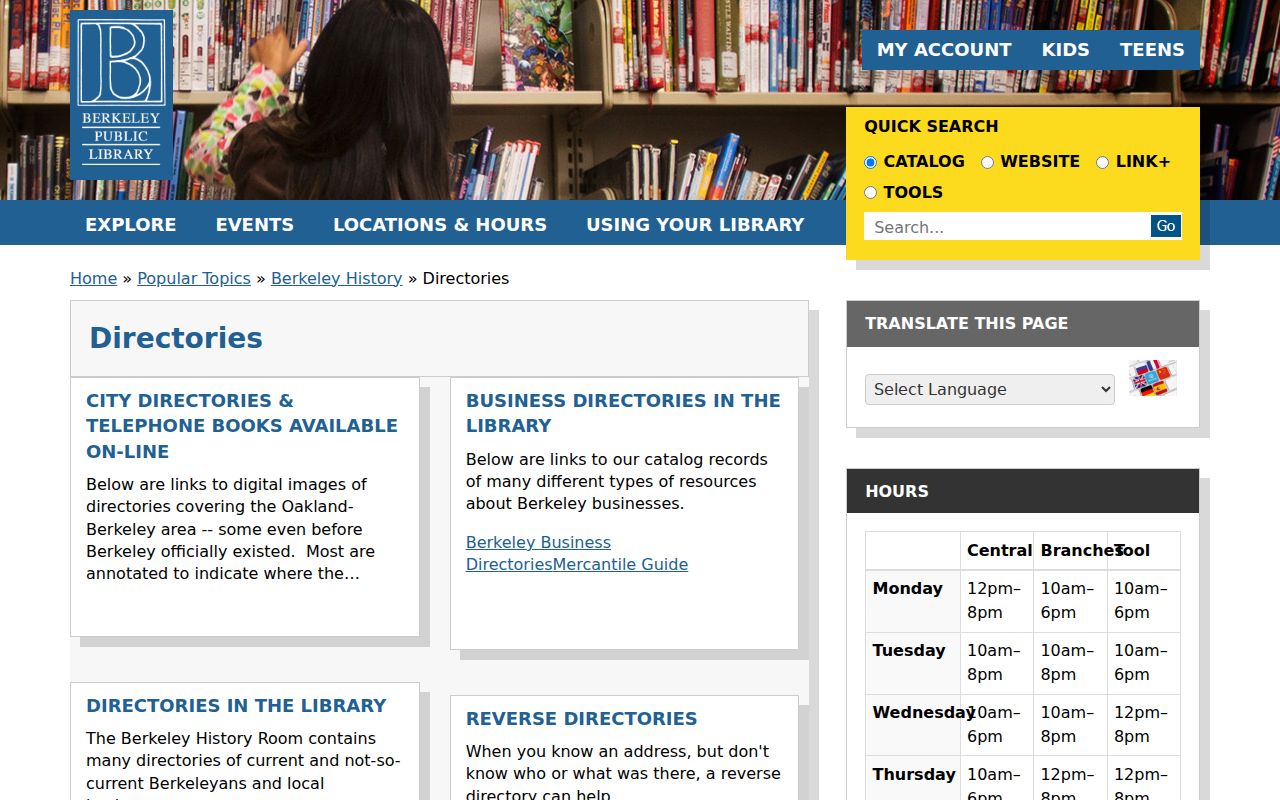
Those holdings make the distinction between a surname search and an address-first subscriber search visible in the collection itself.
Berkeley Reverse Directories Put Addresses First
The PT&T reverse books for 1938, 1940, and 1944 are valuable checkpoints for a Berkeley address because they start with the street sequence and lead to a listed subscriber. Later reverse directories cover 1981-present, and BHS has some 1960s-70s material. These runs can show that a name was associated with an address even when an alphabetic city directory entry is hard to locate.
Read the address-first path as a chain of clues: address → listed subscriber → name variant → alphabetical entry → census or Gazette item. Compare the street sequence with the exact year and publisher. A reverse hit does not establish a complete household, legal ownership, or current occupancy.
When the question shifts from an older listed person to a current parcel or street sequence, the Berkeley street directory keeps modern address-keyed work separate from the historical shelf.
Note: A reverse directory hit identifies a listed subscriber at an address, not the complete household or every person who used that place.
Trace Family History Through Berkeley Directories
A useful Berkeley family-history trail follows a name across editions, then uses the address to test identity. Search initials, nicknames, spouse names, and spelling variants. Record the address, occupation, and business line exactly as printed, because those clues help separate two people with similar names.
- Find the person's first appearance in an accessible Berkeley city directory year and copy the entry without normalizing the name.
- Follow the name through consecutive years, noting every address, occupation, business, and change in initials.
- Check a PT&T reverse volume when the year fits, then compare the street sequence with the alphabetic entry.
- Pair the directory date with local census microfilm for 1860-1930 or public federal schedules through 1950 to add household members and relationships.
- Close the trail with the Berkeley Gazette obituary index, opening the newspaper item rather than treating an index code as the finding.
The obituary index searches Last Name, First Name, Middle/Nickname, Month, and Year, with an asterisk wildcard. Its listed coverage includes 1894-1910, 1920, 1923, 1925, 1930-42, 1951, 1955, 1959-65, 1967, 1970-71, 1977-80, and 1982; other years are in progress. One missing directory year is not proof of a move or death.
The Berkeley Gazette obituary index supplies a focused endpoint for a Berkeley city directory search that reaches a former classmate or family member.
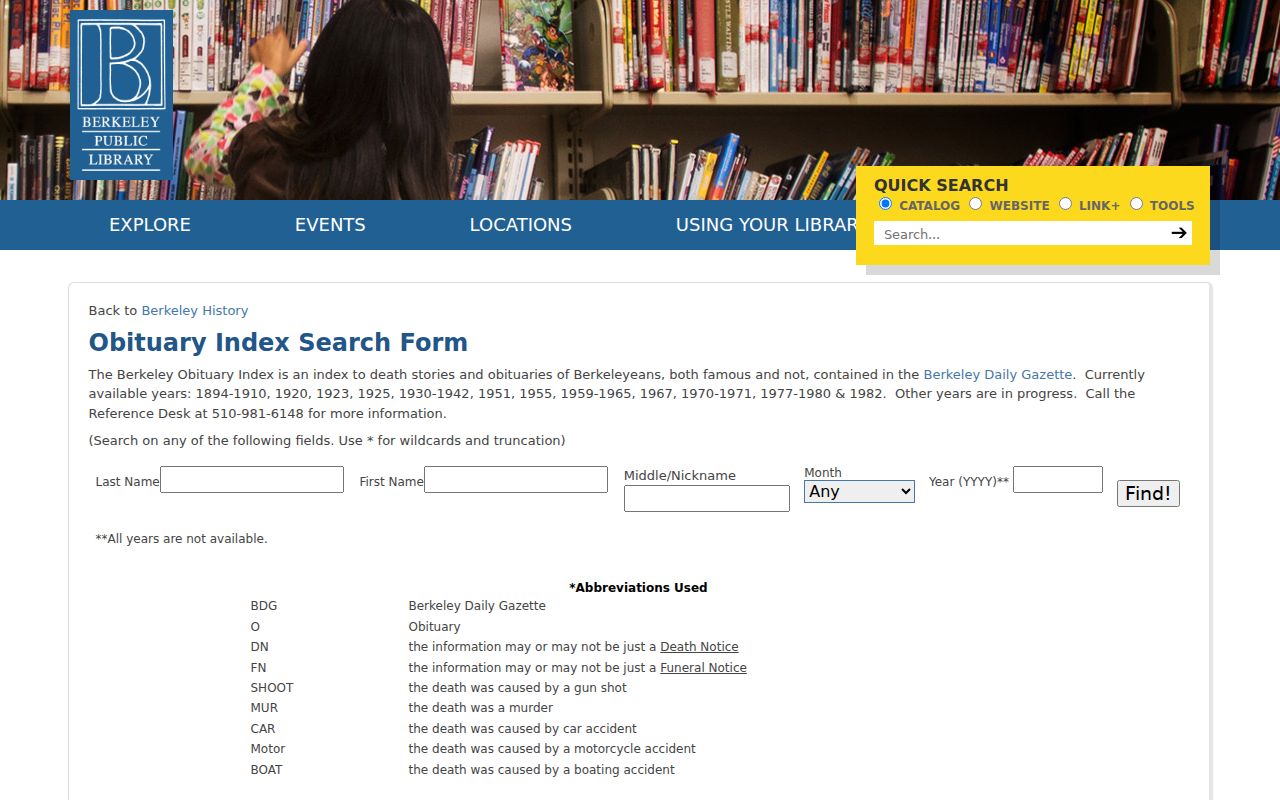
The index codes are catalog cues, so the Gazette item itself remains the evidence for a date, name, or family connection.
Berkeley History Room Directory Research
Berkeley Public Library Central, 2090 Kittredge Street, houses the noncirculating History Room in the second-floor Historic Reading Room. Public hours are Wednesday 10-1. Appointments outside that window go through (510) 981-6100. The room is the practical fallback when a digital city directory link omits a year, a page, or a publisher note.
Its related local-history material includes clippings from 1920-2005, Berkeley Daily Gazette microfilm from 1894-1984, maps, Sanborns, city documents, directories, photographs, posters, underground newspapers, yearbooks, and obituary research. BHS and BAHA extend the shelf with some reverse directories, early permits, block books, and original map material.
Bring a short research log. Note the exact volume, publisher, page, place heading, and role shown for each name. That record makes a later comparison with a census, Sanborn sheet, or reverse directory much easier.
The Berkeley house-history research guide shows how directories fit with Sanborn maps, census material, BAHA records, and block books.
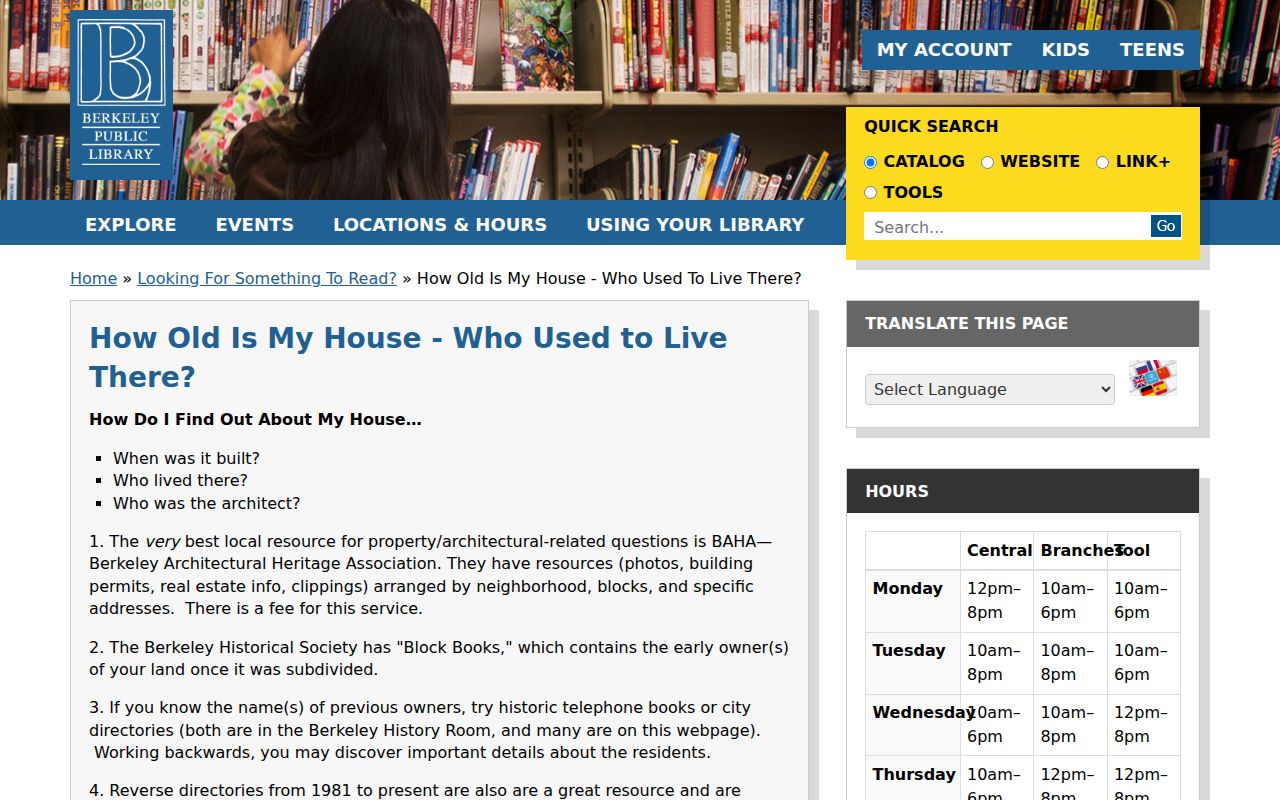
The house-history workflow keeps a Berkeley city directory in its proper role: one dated clue among several local records.
History Room tip. Public access is Wednesday 10-1, with appointments outside those hours through (510) 981-6100.
Berkeley City Directory Companions Beyond the Name
A Berkeley city directory supplies a listed name and place, but the surrounding shelf can explain what that entry cannot. Sanborn checkpoints from 1890, 1894, 1911, 1929, and 1950 document structure footprint, use, and material rather than ownership. Census schedules add household composition. The Gazette, yearbooks, and UC Blue and Gold add dates and relationships that a short directory line may leave out.
The digitized 1894 Berkeley Sanborn collection is a concrete companion for testing the built setting around a city directory address.
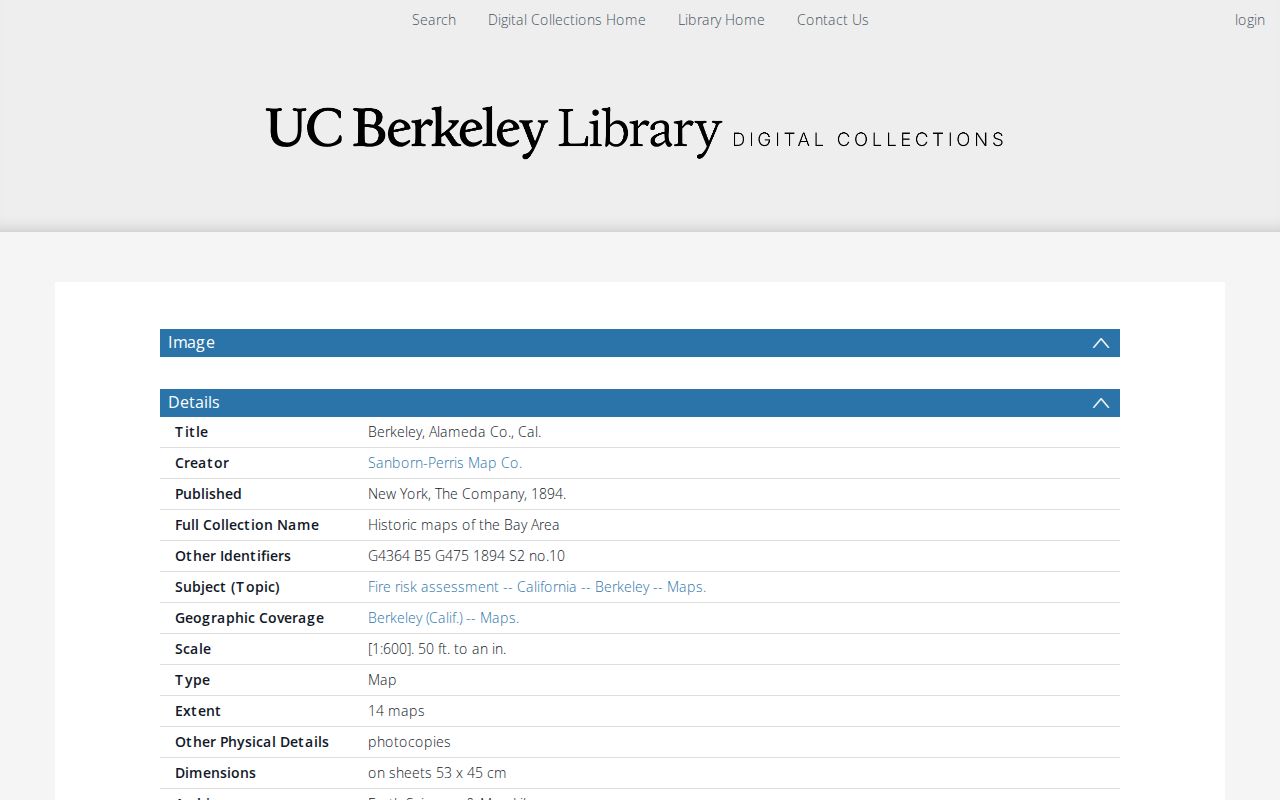
A Sanborn sheet can show whether a lot, building footprint, or use fits the dated entry, while the directory remains the source for the listed subscriber or occupant.
For human-use research, Berkeley High yearbooks are physical from 1943 onward, with a digitization report reaching from 1895 to 2012, and UC Blue and Gold spans 1886-2006. The California Archives family-history resources add census, county, military, prison, and licensing holdings when a local directory trail needs a wider source. The Berkeley Barb's digitized run from August 13, 1965 through April 24, 1980 can add community names and organizations absent from ownership sources. Use these companions to reconstruct former classmates and families, not to turn one brief directory entry into a complete biography.