
Berkeley Previous Residents by Record Era
An address history in Berkeley is built from sources with different clocks. Alameda County official records trace legal ownership, reverse directories trace listed subscribers, census records show households, and Sanborn maps show buildings. The table starts with the current parcel lead and then moves backward, so a previous resident is not confused with a deed party or an address that changed name.
| Source | Years It Covers | Where Held | What It Shows |
|---|---|---|---|
| Alameda County official records | 1853-present; electronic index 1969-present; microfilm index 1853-1968 | Auditor-Controller/Clerk-Recorder, 1106 Madison Street, Oakland | Deeds, liens, maps, parties, and recorded ownership |
| Property search and APN lead | Current parcel record | Alameda County Property Search | Address/APN facts; no public owner-name mode |
| PT&T reverse directories | 1938, 1940, 1944 | Berkeley Public Library digital links | Address to listed subscriber |
| Later reverse directories | 1981-present; some 1960s-70s | History Room and BHS | Listed subscribers in address sequence |
| East Bay and Berkeley city directories | 1867, 1869, 1874, 1875, 1876-77, 1877-78, 1880-81, 1884-85, 1887, 1889-90, 1892-93, 1903, 1908-18, 1921, 1923-28, 1930, 1933-35, 1937-41, 1943 | BPL, BHS, and BAHA | Names, listed addresses, occupations, and businesses |
| Federal census | 1860-1930 local; public schedules through 1950 | History Room and Ancestry | Household members and relationships |
| Sanborn maps | 1890, 1894, 1911, 1929, 1950 | BPL; originals at BAHA and BHS; 1894 UC digital | Structure footprint, use, and material |
| BAHA permits | 1909-1946 | BAHA | Owners, architects, contractors, and construction |
| BHS Block Books | Early subdivisions | BHS | Early owners and subdivision context |
| Donogh address files | Maintained from 1937 | BAHA | Owners, sale prices, photos, and notes |
Start with the source that matches the question. Use the parcel and APN to establish place, the Recorder to trace legal title, reverse books to find listed subscribers, and census schedules to add household context. Sanborn sheets and permits test whether the building and address fit the date. A previous-resident trail is strongest when those separate roles agree without being forced into one answer.
The Alameda County Clerk-Recorder services page provides the county record path behind a Berkeley previous residents search.
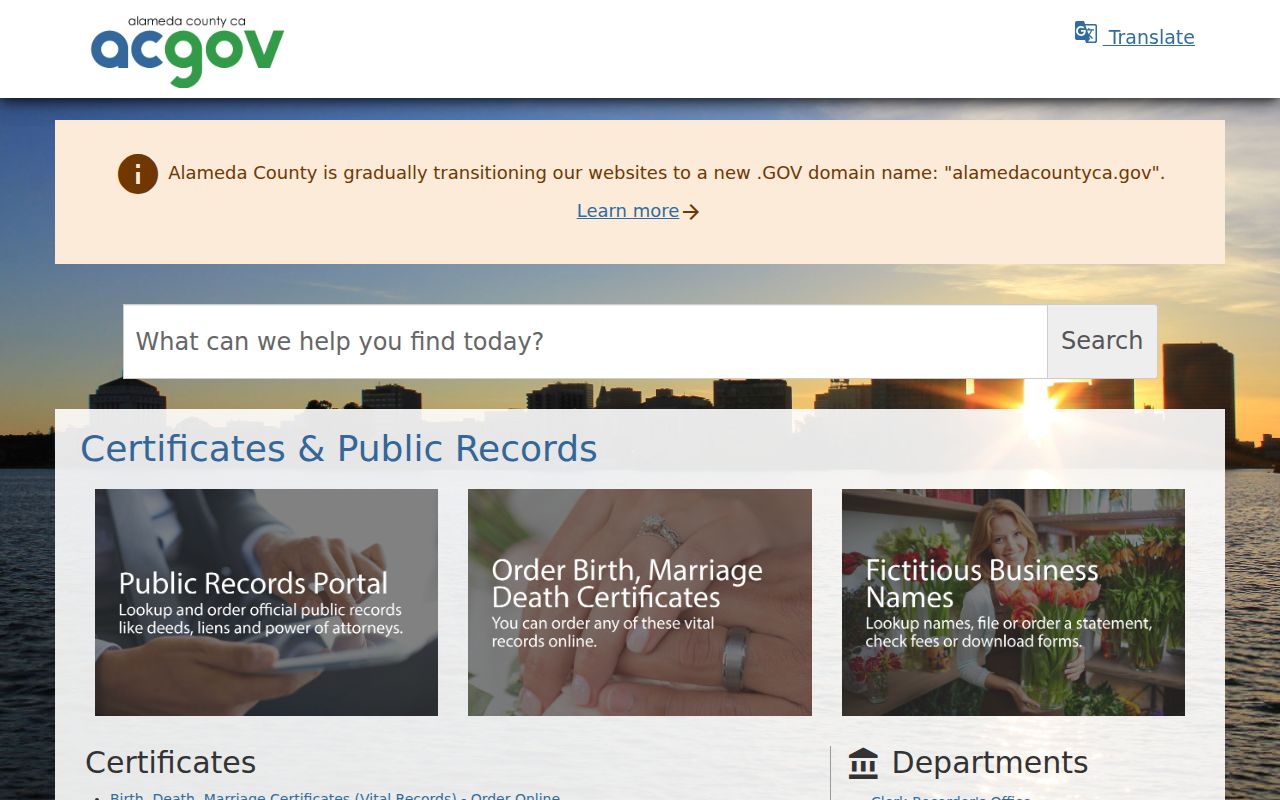
The county office is the legal-record custodian, while the library and local archives supply the occupant and house-history layers.
Trace Berkeley Previous Residents Through the Deed Chain
The backward path is address → APN or current title lead → grantee deed → grantor → earlier chain. Alameda's property interface is address/APN-first and shows no public owner-name mode, so use it to confirm the parcel rather than to claim who lives there. An APN such as 57-2021-1 can bridge assessor, GIS, and deeds, but it is not a postal address or occupancy proof.
Alameda Recorder records are alphabetic by party name, not by street address or APN. Once the current owner or title lead is known, search that party as grantee, capture the acquisition deed and grantor, then search the grantor as grantee. Preserve the instrument number, legal description, subdivision, lot and block, and map reference at each turn.
- Validate the Berkeley address in the property search and capture its APN, situs details, and any current title lead.
- Search the current party as grantee in the electronic official-record index and note the document date and instrument number.
- Read the deed or order its copy, then identify the grantor and the legal description tied to the transfer.
- Search that grantor as grantee and repeat the backward pivot through each earlier transfer.
- When the electronic run ends, move to the grantor/grantee microfilm for the earlier chain.
- Grantor
- The party who transfers an interest in the recorded instrument.
- Grantee
- The party who receives that interest in the recorded instrument.
- Chain of title
- The linked sequence of transfers used to follow legal ownership backward.
- Legal description
- The formal parcel description, subdivision, lot, block, or map reference that can remain stable when a street label changes.
- Criss-cross directory
- An address-first directory section that lists subscribers in street sequence.
- Enumeration district
- The census area assigned for counting households, which may not match a modern street label.
Alameda Recorder Copies for Berkeley Previous Residents
The Alameda official-records service offers a free electronic index for 1969-present, but images and copies are paid. The Recorder's office is at 1106 Madison Street in Oakland. An order can use an instrument number, book and page, or reel and image reference. Allow about two weeks after filing before ordering a record.
| Plain copy | $3.50 per page. |
|---|---|
| Certified copy | $4.50 for the first page, then $3.50 for each additional page. |
| Mail order | Generally 5-10 business days; send a check or money order with a self-addressed stamped envelope. |
| In-person fallback | Printing stops at 4:15; large orders take 1-3 business days. |
The official-record copy order form is useful after the deed index yields a reference. The Recorder does not conduct lien research, so a house-history project must preserve each party and document clue and continue the search itself.
The mail and counter routes matter when a search needs a certified page, when the image is not online, or when the electronic index gives a lead but not the deed text.
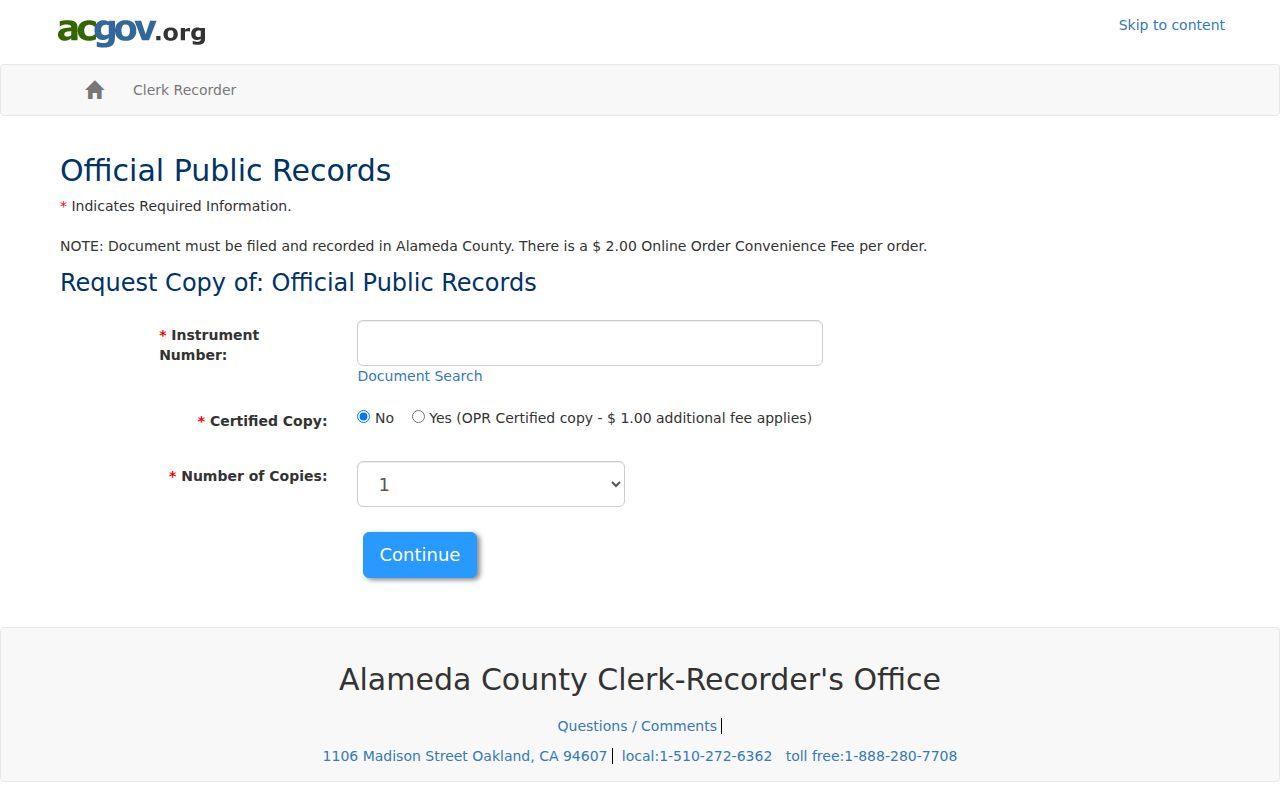
The order form is a fallback channel, not a substitute for recording the party chain that led to the instrument number.
The Berkeley Deed Index Break at 1969
Alameda County's Recorder books reach back to 1853, but the electronic index begins in 1969. The 1853-1968 indexes require in-person microfilm research, so a Berkeley previous residents search that stops at the online cutoff has stopped at an access boundary, not at the start of the property's history.
Carry the last electronic grantor and grantee names, instrument clues, legal description, and map references into the microfilm session at 1106 Madison Street. Earlier land or court work before the county was created in 1853 may require predecessor Contra Costa or Santa Clara jurisdictions, so the date of the deed sets the next custodian.
The California Archives county and city records inventory is a useful companion when the trail branches into older county holdings.
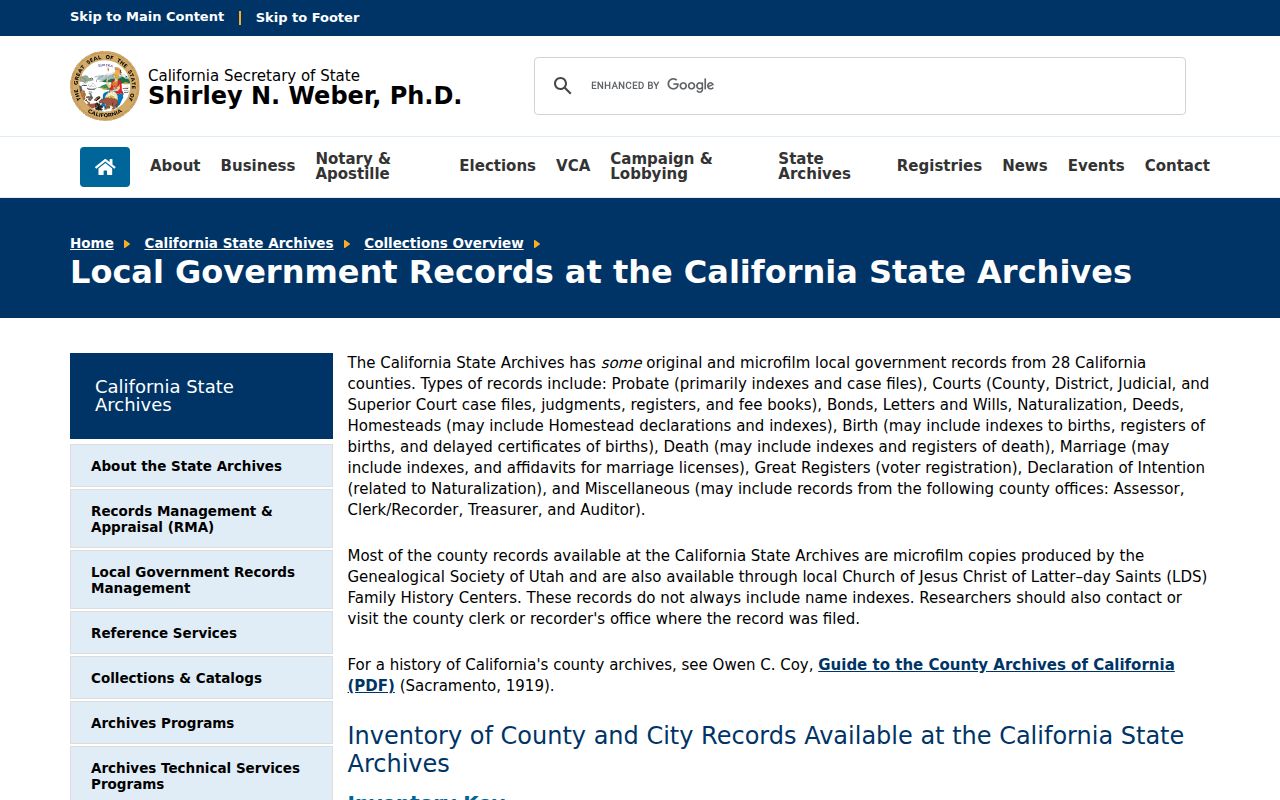
Archives coverage varies by record group, so use it to widen the family-history search while keeping the Alameda Recorder as the deed custodian.
Index checkpoint. The 1969 date marks the electronic search run; it does not mark the beginning of Berkeley ownership or occupancy.
Berkeley Address Changes for Previous Residents
Old address searches fail when a place is treated as a fixed string. In the 1880-81 volume, 2212 Fifth is described as the west side of Fifth, between Allston and Bancroft. Atherton Street disappeared, and Hamilton Street became McGee. Bridge those clues with cross streets, tract maps, Sanborn sheets, legal descriptions, and the surrounding directory sequence.
Unit notation creates another break. Berkeley normally uses lettered units such as 1234-A, 1234A, or Unit A. The city no longer issues fractional addresses or “Lower Unit,” although older directories may contain them. Preserve the old form in the search log, then test the modern form rather than replacing one with the other.
Berkeley's address-assignment process requires a form, a map of nearby addresses, a site plan, and an active building permit for new construction. The nonrefundable fee is $250. Submit materials to buildingandsafety@berkeleyca.gov or the Permit Center; the city verifies ownership, visits after permanent construction begins, chooses a number consistent with nearby addresses, and notifies the Recorder, USPS, utilities, Police, and Fire. Typical processing is 6-8 weeks.
The Berkeley address-assignment rules explain why a historic directory label and a later parcel record may need a bridge before they can be compared.
Berkeley Previous Residents in Reverse Books and Census
Legal owners are only one clock. The PT&T reverse directories give Berkeley checkpoints for 1938, 1940, and 1944, while later reverse directories reach 1981-present and some 1960s-70s material sits at BHS. Census schedules add household members and relationships, but the address may sit in an enumeration district rather than under the modern street label.
- Start with the closest PT&T reverse year and read the street sequence around the address.
- Extend the address trail with the 1981-present reverse shelf or BHS material for some 1960s-70s years.
- Pair each directory date with local census microfilm for 1860-1930 or public federal schedules through 1950.
- Compare names, address form, occupation, and household relationships without treating a subscriber as every person at the address.
- Mark gaps as gaps. One missing directory year is not proof of a move, death, or empty house.
The publisher runs and shelf notes are cataloged with the collections on the Berkeley city directory page. Across the full trail, compare four clocks: deed owner, directory subscriber or occupant, census household, and Sanborn structure. Disagreement is useful because those roles answer different questions.
Berkeley House History for Past Residents
The Berkeley Public Library house-history workflow joins directories, census pages, Sanborn maps, BAHA permits, and BHS Block Books. It is a good fit for a previous residents project because it treats the address as a changing place, not as a single name. Start with the deed chain, then add the sources that can test a building date, a subdivision, or a household.
BAHA permits cover 1909-1946 and can preserve owners, architects, contractors, and construction clues. BHS Block Books document early subdivisions. BAHA's Donogh files, maintained from 1937, preserve address-level owners, sale prices, photos, and notes. Those files can add local context when a formal deed gives the transfer but not the story around it.
Sanborn checkpoints from 1890, 1894, 1911, 1929, and 1950 show structure footprint, use, and material rather than legal ownership. A permit applicant or owner is dating evidence, not proof of every occupant. Keep the date, source, and role beside each name so the house history stays readable.
The Berkeley house-history guide supplies the local sequence for combining these records.
Close the Berkeley Previous Residents Trail
The Berkeley Gazette obituary index can close a past-resident trail when a name, date, or family connection reaches the newspaper record. Search its Last Name, First Name, Middle/Nickname, Month, and Year fields, and use the asterisk wildcard for name variants. Listed coverage includes 1894-1910, 1920, 1923, 1925, 1930-42, 1951, 1955, 1959-65, 1967, 1970-71, 1977-80, and 1982; other years are in progress.
Codes such as BDG, O, DN, FN, SHOOT, MUR, CAR, Motor, and BOAT are catalog cues, not findings. Open the Gazette item on microfilm or through the local index context before drawing a conclusion. If the obituary search is blank, keep the gap visible and compare the directory, census, yearbook, and deed dates instead of declaring that a person was never there.
The Berkeley obituary index is most useful at the end of a chain that already has a name, address, or date to test.
Lawful house-history use. Berkeley previous residents research is appropriate for house history, family history, and personal curiosity. California law addresses stalking and publishing identifying information to incite unwanted contact or harassment, so do not use records to track, threaten, or harm a living person.