
How Berkeley Residents Are Found
Every search starts with a clue. A Berkeley residents directory hunt works best when that clue picks the record. An address points to the Alameda County property search or the GIS parcel map. A name can lead many places. The recorder's party index, a court case, a license, or an obituary might each answer it. Old households appear elsewhere. City directories, census schedules, yearbooks, and newspapers hold them more often than any current roll does. Each record answers a different question. A first hit is a lead, not a final match.
Begin with a source you can check. Property and tax tools tie an address or APN to parcel facts, but they never prove who occupies a dwelling. Deeds name the parties to a recorded transfer and no one else. A voter status account authenticates a person's own registration, not a Berkeley street browse. Historical directories list a subscriber or occupant, not a whole household. Names alone deceive. Those distinctions keep the residents directory useful for family history, reconnecting, estate work, and civic research.
- Write down the known name, address, date, APN, spouse, middle initial, or document clue.
- Use Alameda property or Berkeley GIS tools to validate an address and parcel relationship.
- Move from a parcel lead to the recorder’s party index when ownership history matters.
- Use the proper authenticated, historical, court, vital, or license source for the person question.
- Ask the custodian, library, archive, or city records program when an online index stops.
Where Berkeley Resident Records Live
Berkeley's records split three ways. The city keeps its own files. The City Clerk at 2180 Milvia Street manages municipal records, elections, and filings. The office also runs the records program. Alameda County's Recorder and Assessor work from Oakland. The state runs the vital, voter, licensing, and confidentiality systems. That split is why a Berkeley residents directory is a set of linked trails. It is not one government list.
These offices are the practical starting points. The county Recorder holds deeds, liens, maps, and other official records. The property search takes an address or an APN first. The state voter tool is an authenticated self-lookup only. City permit, planning, police, and administrative records stay in Berkeley. The Public Library History Room supplies the strongest offline directory shelf.
Alameda County Recorder
1106 Madison Street
Oakland, CA 94607
(510) 272-6362
Official Public Records
Alameda County Assessor
Address and APN search
Owner-name mode not displayed
Lobby access 9-4:30
Alameda Property Search
California Elections
Authenticated self-lookup
Qualified files by application
Purpose limits apply
My Voter Status
Berkeley public-records access information is the city's own records hub.
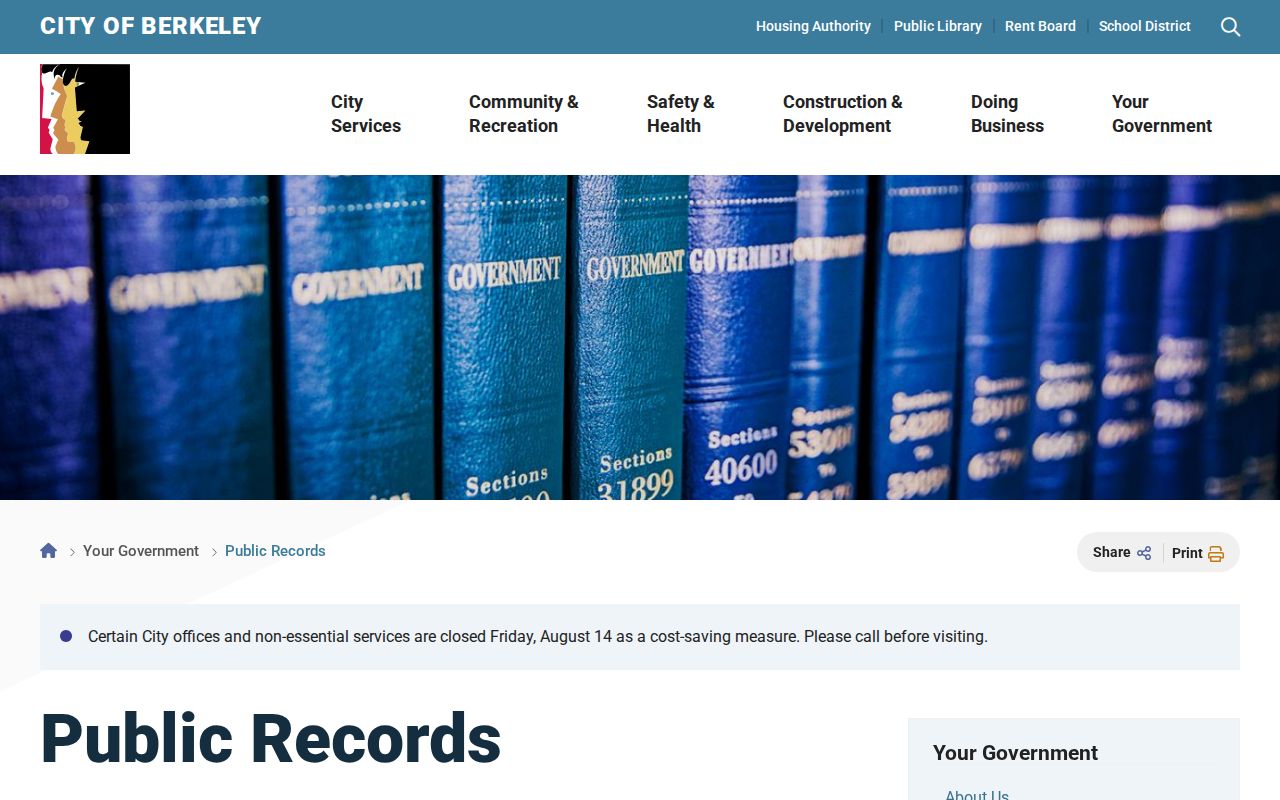
The city office handles anything municipal. County and state custodians hold the identity-bearing sources instead, so the right channel depends on the record.
Note: Oakland is Alameda County’s seat, so county counter research for Berkeley generally points away from the city.
Berkeley’s Address-First Property Search
The Alameda County property search anchors this part of a Berkeley residents directory hunt because it starts with property, not a person. Its public modes offer a parcel-number field, a type-ahead address selector, and a property-address search. The assessor tool publishes no public owner-name field. That limitation shapes everything. A name cannot be typed in to pull a citywide list of Berkeley owners.
What the parcel result gives is worth saving. Record the APN, situs address, mailing address, use or class information, latest document date, and other parcel facts. A situs address marks the place the parcel serves. A mailing address shows where tax material goes. Neither proves who lives there. The county tax search offers another address or APN route, and the Berkeley GIS portal ties the parcel to planning and building layers.
| Parcel Number | Text or parcel mode; an example format is 123-345-67. |
|---|---|
| Type Ahead Address | Autocomplete; select the offered address suggestion. |
| Property Address | Address-first search mode for a parcel lead. |
| Search and Reset | Controls only; no public owner-name field was shown. |
That design teaches a Berkeley-specific lesson. A parcel can carry a search to a deed, permit, or old city directory, yet no public property record becomes an occupancy list. Names never fall out of it. The address trail stays honest when each later record is checked against its own custodian.
Berkeley’s 1969 Recorder Cutoff
Alameda County official records reach back to 1853. The electronic deed index only begins in 1969. For 1969 forward, the Recorder's official-records page supplies the modern index. For 1853 through 1968, the grantor and grantee indexes live on microfilm. View them in person at the Clerk-Recorder. A blank online search does not mean an older Berkeley deed never existed.
The index runs by party name, not street or APN. For a copy request, bring an instrument number or a book and page. A reel and image reference also works. Plain copies cost $3.50 per page. Certified copies run $4.50 for the first page and $3.50 for each additional one. Mail orders take 5 to 10 business days. Large in-person orders may take 1 to 3 business days. The office does not conduct lien research.
Timing matters too. Electronic indexing lags filing by about two weeks. Wait before expecting a fresh document to appear or ordering a copy. Any Berkeley deed chain reaching before 1969 must continue at the counter or on microfilm. That cutoff can change the whole search plan.
Coverage comes first. The county's official-records page lays out the modern and pre-1969 access split. A blank search never has to stand as a conclusion.
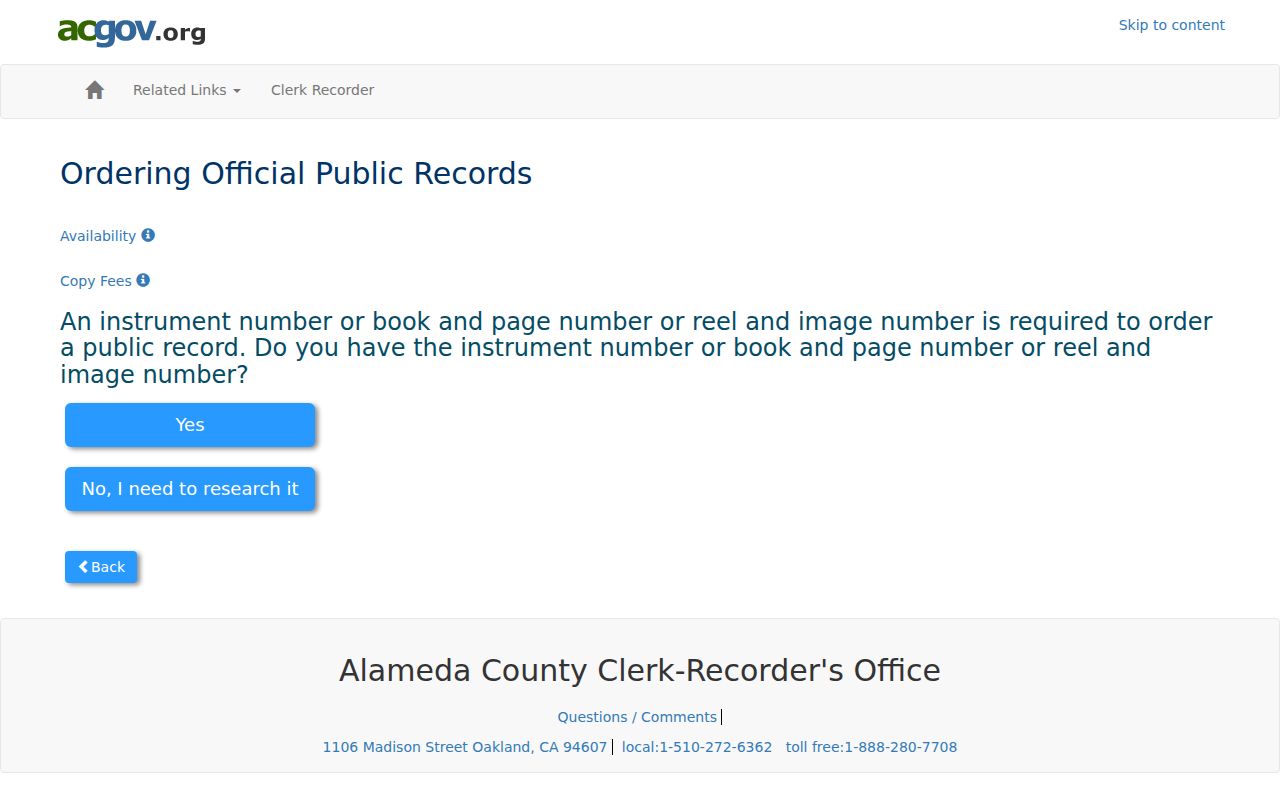
Treat the index as a map, not the destination. The deed image and the legal description carry more weight than any name-only result.
A Berkeley Voter Lookup Has a Narrow Door
My Voter Status answers one person's question. It is not a public Berkeley residents directory. The form demands a first name, last name, date of birth, and either California driver license or identification details or the last four digits of a Social Security number. Pass that gate and you can see your own registration status and address, party preference, polling place, election information, vote-by-mail or provisional status, participation history, and guide preference.
The authentication protects the line between checking your own record and browsing other people. California Elections Code section 2194 and Government Code section 7924.000 keep voter data restricted. Qualified election, scholarly, journalistic, political, and governmental users may apply for the file. The application is demanding. It requires a purpose, scope, delivery method, acknowledgments, a wet signature, photo identification, and a fee. Commercial solicitation, harassment, and fraud are barred. The public page cannot list Berkeley voters.
The voter-status form cannot enumerate voters by name or by street, which is why a result is a verification step rather than a neighborhood roster. Wait 24 hours after a new online registration. Then the status updates.
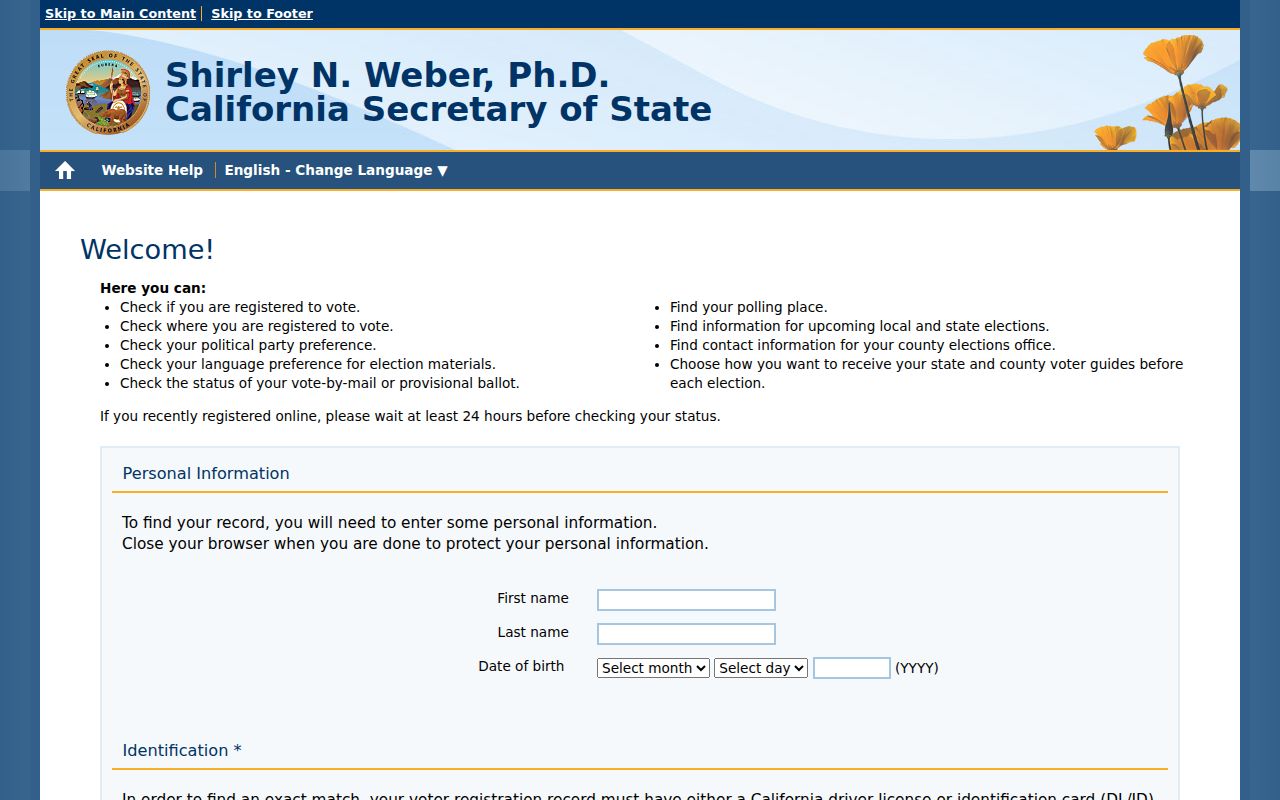
The form's fields serve a person checking their own record. Historical or address research needs a different, lawful source.
Present-Day Berkeley Resident Sources
Modern Berkeley resident sources are really toolkits. Each one answers a different question. The assessor and tax systems supply property facts. The recorder lists parties to recorded documents. The city's active-license data shows business registrations rather than residences. The state adds voter status, professional licenses, and entity filings. Every source carries its own access rule. Each one also carries its own risk of mistaking an affiliation for a home.
| Source | What It Lists | Keeper | Access |
|---|---|---|---|
| Property and tax search | Parcel facts, situs and mailing details | Alameda Assessor / Tax Collector | Free address or APN search |
| Official-record index | Deed and lien parties | Alameda Clerk-Recorder | 1969-present online; older microfilm |
| My Voter Status | One person’s authenticated status | California Secretary of State | Self-lookup only |
| City active licenses | Business and location registrations | City of Berkeley | Open Data list or download |
| DCA and business files | Professional or entity affiliations | California regulators | Free metadata searches |
A city staff entry, chamber membership, professional license, or business filing can explain why a name appears in Berkeley without proving residence. Business-license material warns that business emails are public. That affiliation is not a residence. Use the Berkeley resident lookup workflow when one person must be verified across more than one independent source.
One Person, Two Berkeley Matches
A trustworthy Berkeley residents directory result usually needs two independent matches. Preserve every clue. Middle initials, suffixes, alternate spellings, spouse names, dates, and address hints all help separate people. Then sort the roles. Owner, tax-mail recipient, subscriber, and occupant differ. The property portal may find the right parcel. A deed can confirm the owner, and a directory or census can tie a person to the address in a particular year.
Common names need a second fact. A business or professional file adds a license number, entity number, practice location, or filing date, while a court record adds a case number and party name. An obituary contributes relatives or a death date. A "no match" may just mean a spelling variant, a restricted record, a source gap, or a person never represented in that collection.
| Source kind | Strength | Limit |
|---|---|---|
| Official parcel, deed, court, or vital record | Named custodian, defined fields, traceable access | May be restricted, delayed, fee-based, or split across offices |
| Library directory, census, yearbook, or obituary | Dated context and household clues | Coverage gaps, listed roles, and historical spelling changes |
| Commercial people-search compilation | May gather several public-source leads in one interface | Can merge names, lag behind corrections, and lacks custodian authority |
Identity check. An address, date, APN, case number, yearbook year, or document number is a stronger anchor than a shared name alone.
Berkeley Court Records by Case Type
Berkeley cases belong to Alameda County's Superior Court. There is no separate Berkeley municipal court. A Berkeley label on a filing still means a county Superior Court location. The eCourt Public Portal covers civil, family law, probate, mental health, and adoption functions. Every function requires account registration first. Search results can show case and party information. The document area offers a half-page preview, while downloading or printing documents carries charges. Exact party-search fields and prices sit behind the account gate.
Access depends on the case type. Nonconfidential criminal documents use a Criminal Record Request route. Mail searches and public civil terminals at the Rene C. Davidson Courthouse offer alternatives. Family-law documents are not online remotely. Probate images are generally available for filings after January 31, 2006, with exceptions for conservatorship, guardianship, and confidential material. Adoption records require a court order, and juvenile access uses a JV-570 petition under Welfare and Institutions Code section 827. Federal matters go through PACER in the Northern District of California, which charges per search and page, while sealed cases and protected personal identifiers stay unavailable.
Berkeley Birth, Death, and Marriage Records
Vital records live with the right custodian. The Alameda County Clerk-Recorder handles county events, and the California Department of Public Health Vital Records offers a statewide channel. Copy type matters just as much. An informational birth, death, or public-marriage copy carries a notice that it cannot establish identity. An authorized copy can establish identity, but the requester must qualify by relationship or status and submit a notarized sworn statement when required.
Statewide birth records run permanently from July 1905. Older family research leans on Alameda marriage microfilm from 1854 to 1955, plus newspapers, probate, church registers, cemeteries, and the California Death Index. No simple statewide rule opens every modern vital record after a set number of years. Adoption and confidential marriage records are narrower still. Ask the custodian before assuming access.
The Berkeley History Room Offline Directory
For an offline residents directory experience, few places beat the Berkeley History Room at the Central Library. It occupies the second-floor Historic Reading Room at 2090 Kittredge Street. Hours are limited. The room welcomes the public on Wednesdays from 10 to 1. Appointments outside that window can be made by calling (510) 981-6100. Nothing circulates. The shelves hold directories, reverse directories, telephone books, maps, Sanborn sheets, city documents, photographs, and yearbooks. The collection also includes Gazette microfilm from 1894 to 1984 and clippings from 1920 to 2005.
The Library’s Berkeley History Room page opens the door, but the volumes themselves reward a visit. Staff guidance matters when a city directory interfiles Berkeley with Oakland. It also matters when one points toward an institutional section buried in the back. The room also keeps the California Death Index 1940-1997 and supports house-history work. A past resident search can travel from a name to a street address. From that address it can reach a newspaper page or a map sheet. Few offline resources connect so many record types under one roof.
Next door in civic terms sits the municipal office that complements the library shelf. The Berkeley City Clerk department information describes that office. It also explains its role in the wider records landscape.
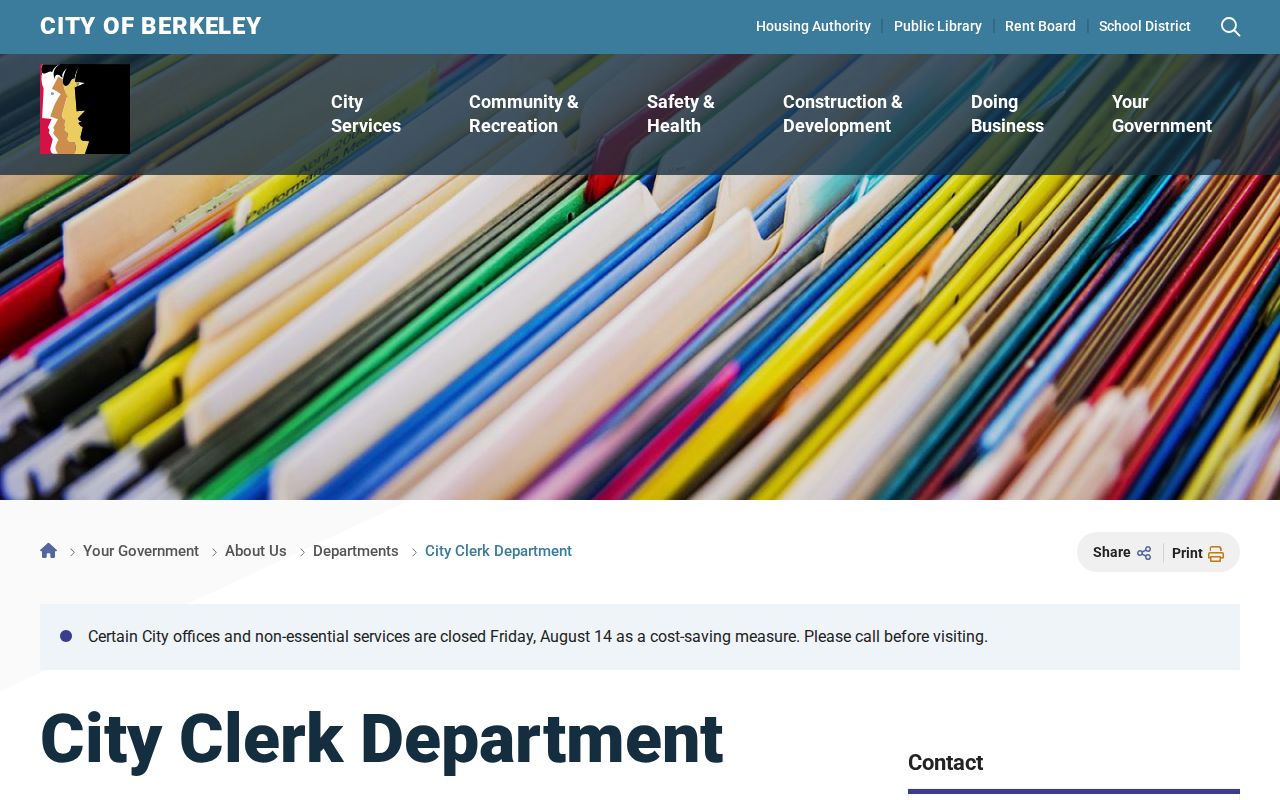
Preparation saves the visit. Bring the exact name, a year, and any street clue you have. A librarian can then steer you to the right directory, reverse volume, obituary index, or map before the search becomes a stack of unrelated books.
Historical Berkeley Resident Directories
Berkeley's directory trail starts before city incorporation. Surviving East Bay and Berkeley volumes cover 1867, 1869, 1874, 1875, 1876-77, 1877-78, 1880-81, 1884-85, 1887, 1889-90, 1892-93, 1903, 1908-18, 1921, 1923-28, 1930, 1933-35, 1937-41, and 1943. Langley, Stilwell, Bishop, Polk-Husted, Husted, and R.L. Polk dominate. They account for the documented runs. From 1923 forward, Berkeley may be interfiled with Oakland, and the linked 1967 and 1969 volumes are Oakland only, a local catalog trap.
Reverse directories flip the angle. PT&T volumes from 1938, 1940, and 1944 lead from address to subscriber. Later reverse directories run from 1981 to the present. Some 1960s and 1970s holdings sit at the Berkeley Historical Society. The Berkeley city directory collections page tells the full story. The central lesson is simple: a directory line is a dated listing, not a complete household roll.
- Roll
- A record set organized around a category, such as property or registered voters.
- Index
- A finding aid that points to a document; it is not always the document image.
- Parcel
- A mapped unit of land identified by an APN, with facts that may connect to deeds and permits.
- Criss-cross directory
- An address-order or street-order directory that can lead from a place to a listed subscriber.
A missing directory year is not proof of departure. The person may have moved, died, changed initials, gone unlisted, or landed under an Oakland-Berkeley heading. Pair the directory years with census schedules, yearbooks, obituaries, and Sanborn maps. That corroboration beats treating one blank line as final.
Protected Berkeley Addresses and Opt-Outs
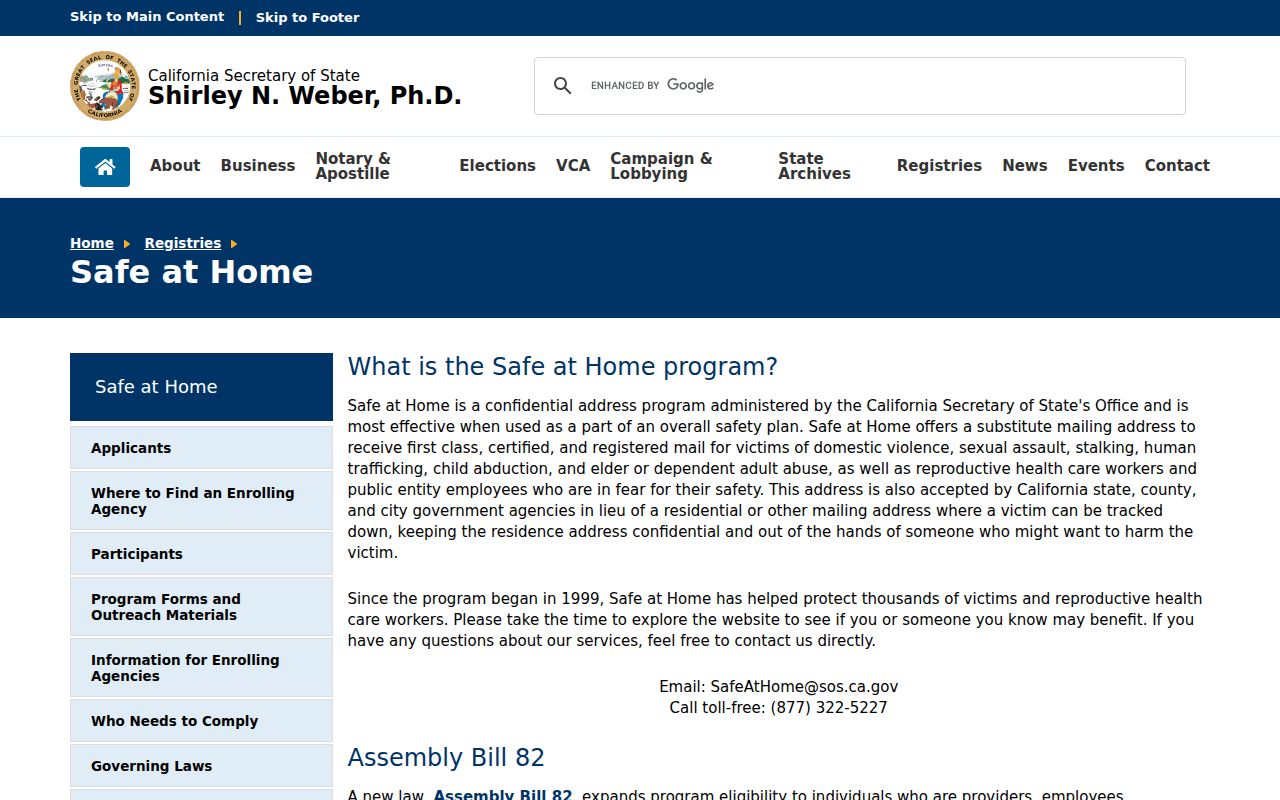
Some Berkeley residents are hard to find on purpose. California's Safe at Home program gives qualifying survivors and threatened persons a substitute mailing address, confidential voter registration, mail forwarding, and certain name, DMV, and property protections. It does not erase older deeds, parcel records, court material, or printed directory pages. A missing name may therefore signal a protection program rather than a missing person.
The California Consumer Privacy Act adds its own toolkit. Residents gain rights to know, access, delete with exceptions, correct, opt out of sale or sharing, and limit sensitive-data use. Global Privacy Control counts as a valid signal. Since January 2026, the state's DROP platform lets a Californian send one encrypted request to every registered data broker. Broker processing begins August 1, 2026. Deleting a commercial profile does not rewrite a Berkeley deed, voter source, parcel, or court record.
Safe at Home explains the protective route. California DROP addresses the broker copies. Neither is a public residents directory. Neither should be treated as a way around a records custodian's rules.
Privacy choices change what a lawful search can show. Respect the protected address, and use the official contact route for a record correction or safety concern.
Lawful use. Berkeley records are for personal, lawful research and civic understanding. Do not use a name, address, or record trail to stalk, harass, intimidate, or harm anyone.
Berkeley Business and License Clues
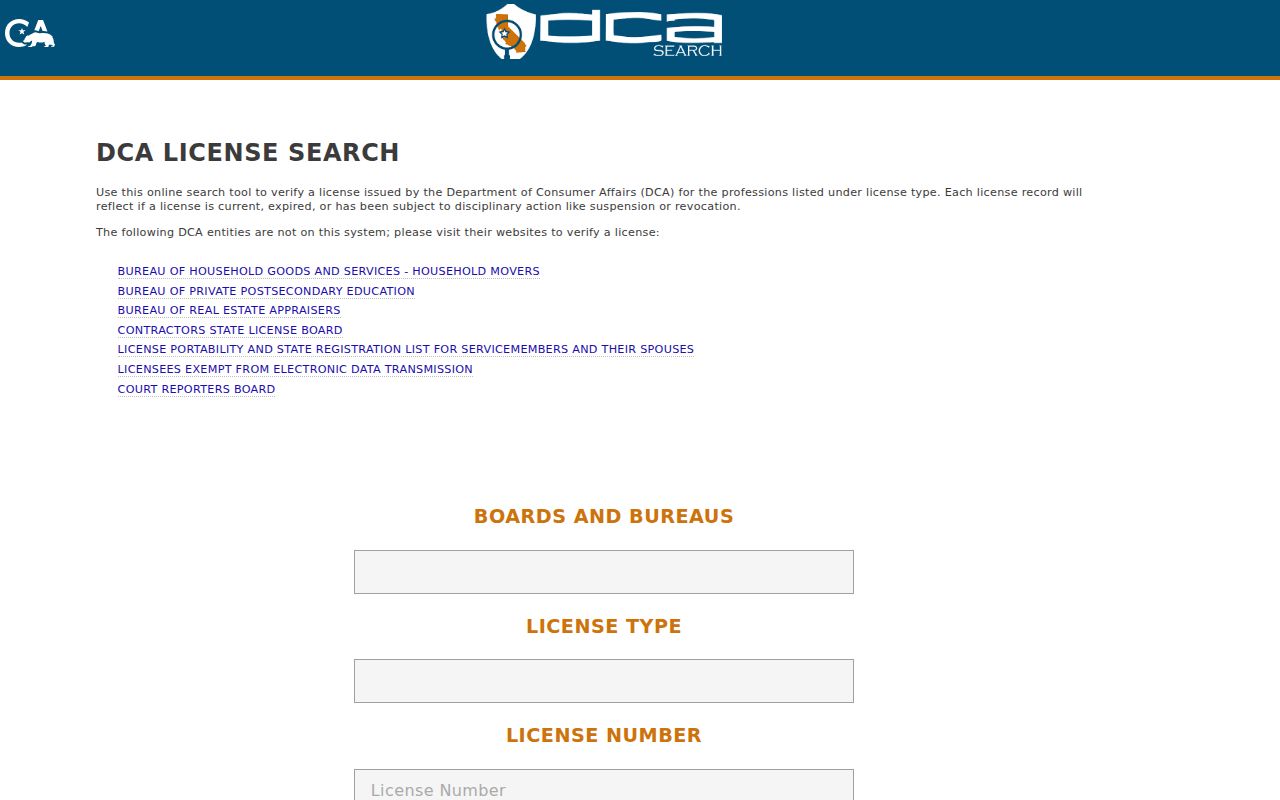
Business and professional databases can explain a Berkeley name. They are affiliation sources, though, not resident rolls. California's DCA license search accepts board, license type, number, business, and first or last name fields, with filters for city, county, status, and discipline. The ABC lookup takes license number, licensee, address, city, and DBA. It can report by city or ZIP. A license locates a practice, not a home.
The Secretary of State runs bizfile Online. Its search takes an entity name or file number, with advanced filters for entity type, status, date, and public-company status. Results can expose entity data plus recent Statements of Information or filings. Transaction features may require an account. One quirk matters. The keyword search drops the "C" from an entity number, so the advanced field can beat a pasted string.
The California DCA license search helps when a name needs a license number or issuing board.
Read each result as one match. It grows stronger when the name, city, date, and address lead agree with a separate record, such as an entity filing. California bizfile Online supplies that entity and filing metadata.
An entity filing proves an affiliation, never a residence.
Berkeley Record Fees and Scam Signals
Fees tell you who is real. Berkeley lets you review city records for free. Paper copies run 10 cents per single-sided page or 20 cents double-sided. A disclosure determination usually lands within 10 days. The city can extend that by 14 days if it needs more time. Requests go through NextRequest, the City Clerk, mail, or an in-person visit. You may stay anonymous: the records still reach you, though account updates will not.
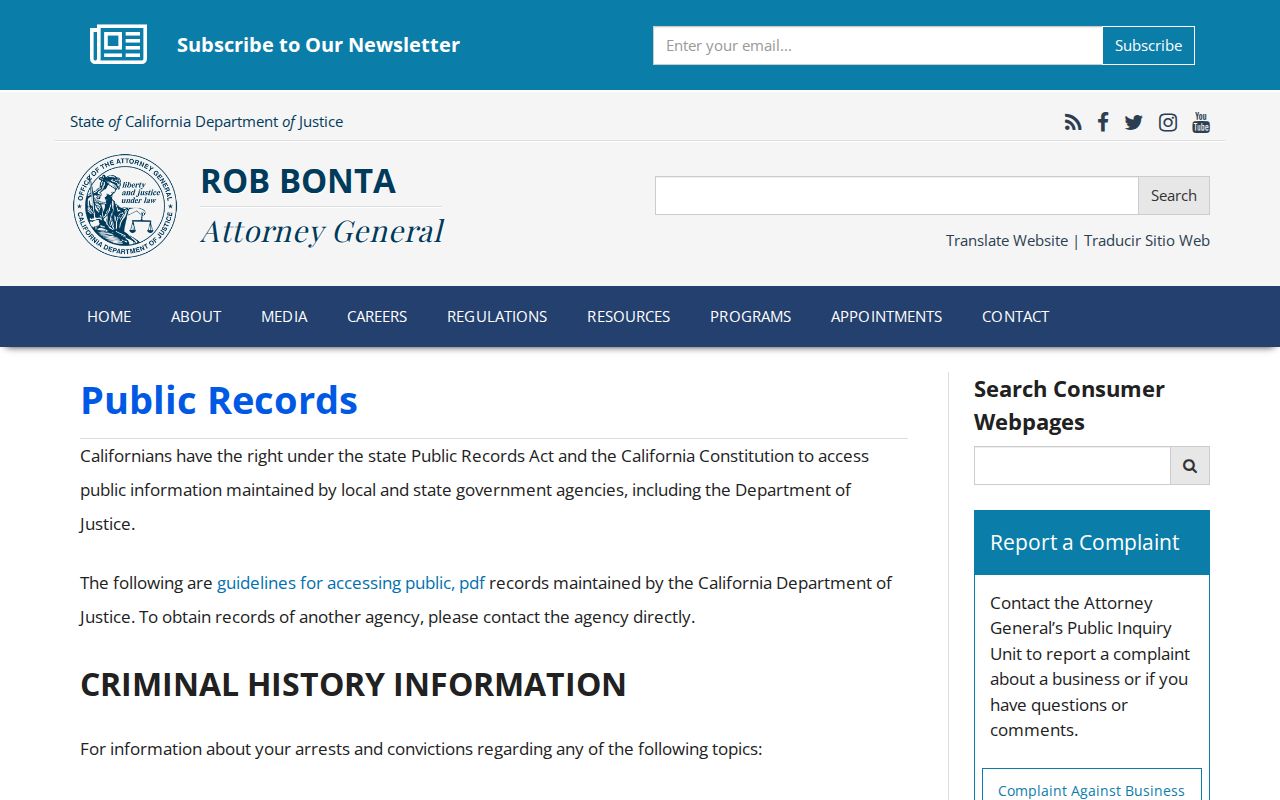
Scammers love real-record language. Beware overpriced deed-copy offers, property-fraud mailers that sell anxiety, upfront-fee promises about unclaimed property, jury-duty arrest threats. Also beware impostors who lift facts from an obituary. Go to the custodian's own government site instead of clicking a link. Compare the posted fee and call the office's published number. Need to file a complaint? Keep the envelope, caller ID, receipt, URL, or screenshot as evidence. California Public Records Act guidance confirms the 10-day determination window, the possible 14-day extension, and duplication costs limited to direct expenses. Berkeley's own public-records page lists the city's request channels.
A public-records request will never match the speed of a search box. Still, it is the right fallback whenever the city holds the record and nothing is already posted online.
Berkeley’s Directory Trail Is Layered
The strongest Berkeley residents directory search keeps four clocks running side by side. These are the deed owner, the directory subscriber, the census household, and the structure drawn on a Sanborn map. Berkeley grew from 5,101 residents in 1890 to 122,580 in 2020. That growth redrew streets, split subdivisions, relabeled units, and thickened the paper trail. Someone can drop out of one clock yet stay plainly visible in another.
Let the question pick the method. Chasing one named person means holding the identity anchors and matching across independent sources. Working from an address means locking down the APN and legal description. Then you follow the deed chain. A historical household comes together through the library shelf, census, obituary index, yearbook, and map. They are used as one set. For a ZIP, remember that postal geography ignores city and county lines. Kept in their proper roles, Berkeley's official records, public directories, and historical sources each answer their part. Each one answers its part of the question.
Note: Validate the clue, choose the custodian, record the date and access limit, then confirm the result with a second source.